
A bigger fund won't fix your Venture Studio. More companies per dollar will.
Venture studio economics broke in 2025, and not for the reason most people think. The constraint isn't access to capital. It's that cost per company launched is a fixed number, and every lever the sector has ever pulled assumes it isn't.
Key takeawaysVenture studio funds grew from 6% to 13% of new emerging funds in 2025 — but with leaner targets, around $6.4M versus $10.6M for traditional funds.Studio ownership at formation has fallen from a historical 80–90% to roughly 25%, driven by founder-quality and downstream-round concerns.LPs now require a written liquidity strategy at diligence. Most studios cannot produce one.The core metric — cost per company launched — is fixed, while the only lever to move it (raising more) has stopped working.Any credible answer has to satisfy six constraints simultaneously. Most proposed solutions fail two or three immediately.
What came back was a paragraph about strong exit potential in the portfolio. The LP passed. Vault Fund now requires a side letter from every studio it diligences, setting out exactly how and when capital comes back. Most studios cannot write that letter, because most studios have never had a mechanism to describe — only a hope to restate.
That is the actual state of the venture studio market in 2026. Not a funding drought. A structural question nobody built the model to answer.
What is the real constraint on a venture studio?
A studio's core metric is cost per company launched. Team cost divided by ventures created.
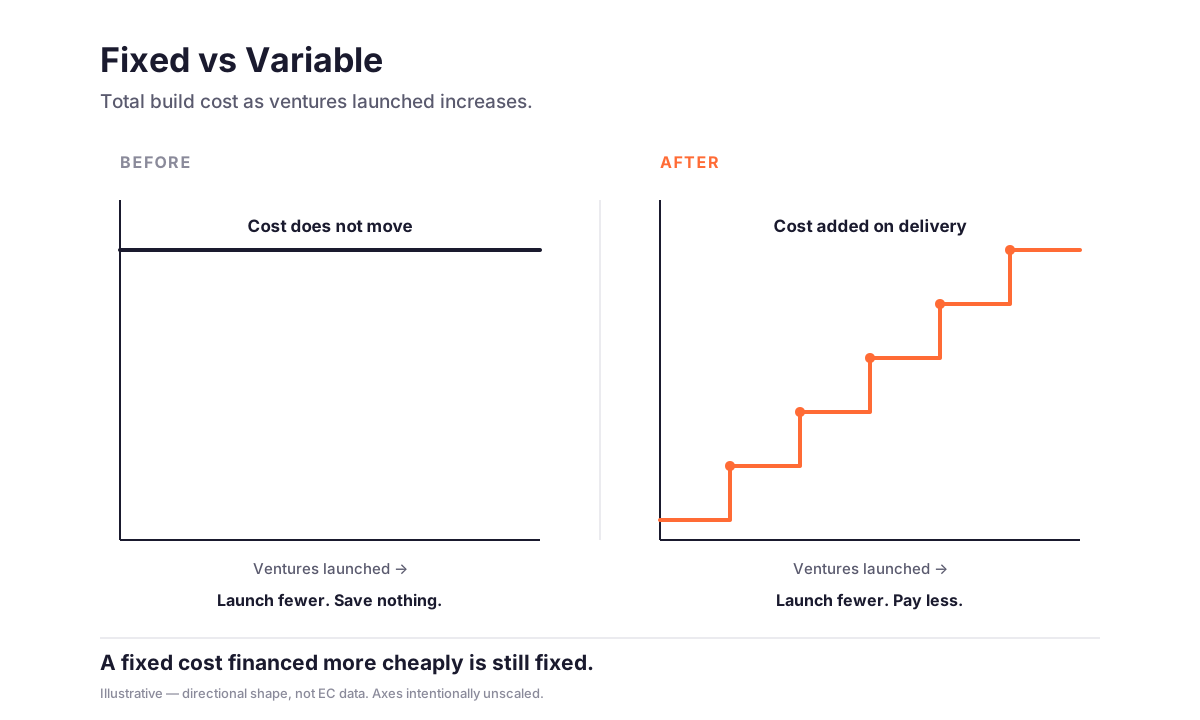
The numerator is fixed. Product, design, engineering, go-to-market — a standing bench that costs the same in a month you launch nothing as in a month you launch two. Operating costs for a studio run materially higher than a comparable venture fund, and they run continuously.
The denominator is capped by capital. More ventures requires more cash, which requires a bigger fund, which requires a raise.
So the only lever any studio has ever had is: raise more.
Why can't venture studios just raise a bigger fund in 2026?
Because the raise lever is broken, and not temporarily.
2025 was on pace to be the weakest venture fundraising year in a decade. LP net cash flows have been negative by roughly $169 billion since 2022. Seventy-two percent of LPs report reducing — not rotating, reducing — their venture allocations.
The mechanism is simple and self-reinforcing. GPs cannot exit, so they cannot distribute. LPs receive no cash, so their venture allocation stays artificially high on paper and they cannot commit to new vehicles. Roughly $947 billion sits locked across 58,000-plus private companies.
Studios feel this harder than funds. A fund that cannot raise deploys slower. A studio that cannot raise still pays the bench.
There is a counter-signal worth noting. Studio funds went from 6% of new emerging funds in 2024 to 13% in 2025, and they raise leaner — around $6.4M average target versus $10.6M for traditional funds. LP appetite for the model is real.
But look at what that number is telling you. Leaner targets mean smaller denominators. The market is funding studios to build fewer companies, more carefully, with a tighter thesis. That is not a solution to cost per company. That is a smaller version of the same equation.
What happened to venture studio ownership percentages?
For most of the model's history, the compensating factor was ownership. Studios took 80–90% at formation. High cost per company was survivable because the stake was enormous.
That is over. The best-performing studios now target around 25%, and the reason is not LP greed — it is selection. Heavy studio ownership correlates with weaker founders, harder downstream rounds, and cap tables that later investors will not underwrite. Studios that hold too much attract people willing to accept holding too little.
So the sector was told, correctly, to take a third of the equity it used to take.
Nobody told it how to take a third of the cost.
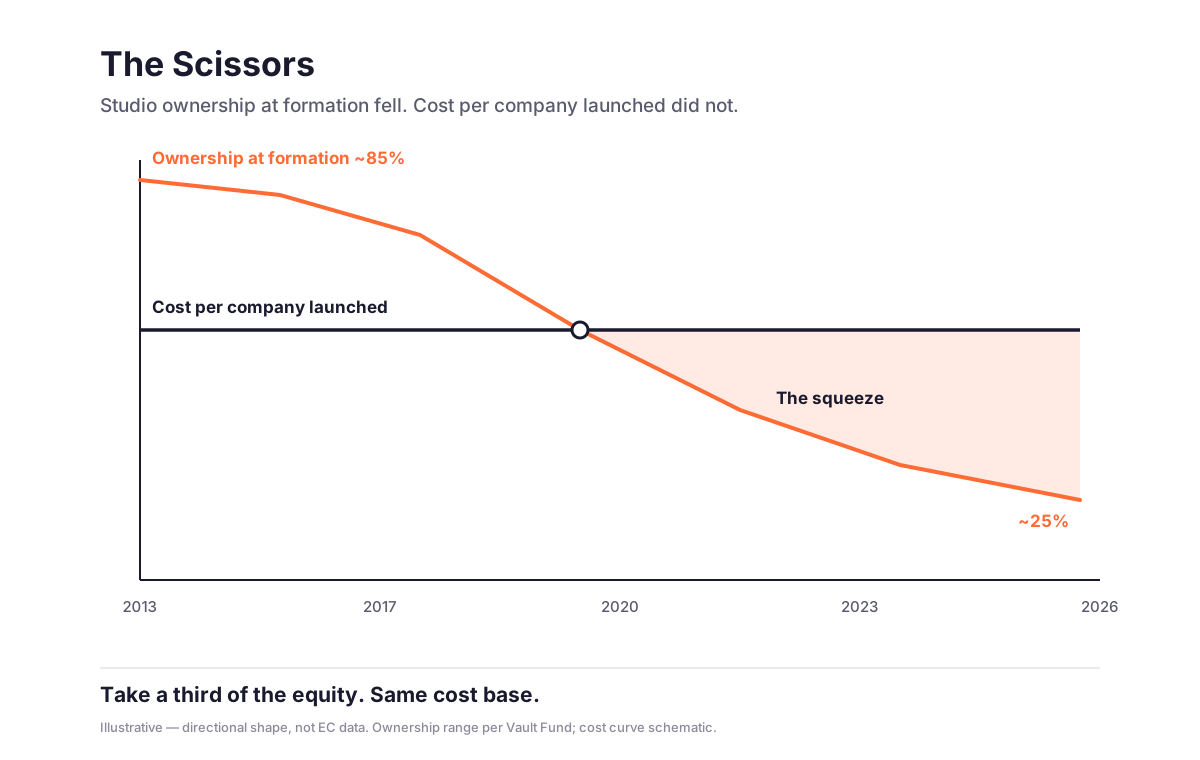
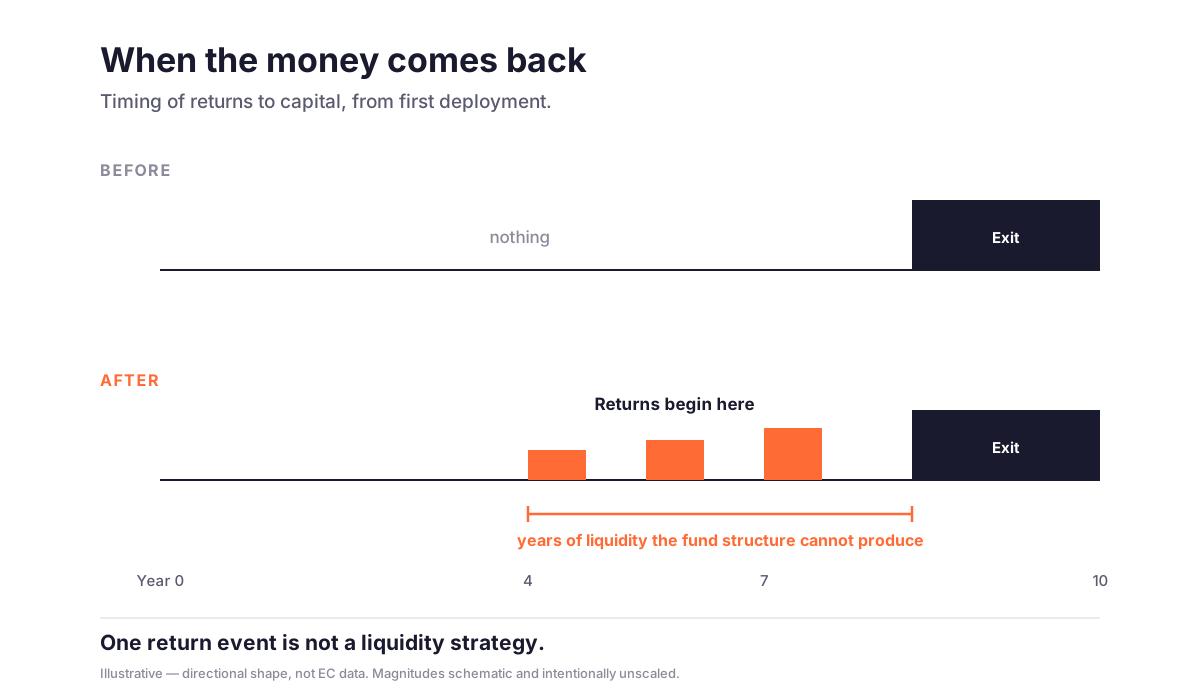
That is the squeeze. Same fixed numerator. Compressed ownership. A raise lever that no longer moves. And an LP base that now opens diligence by asking how the money comes back.
Is a venture fund the right structure for a venture studio?
Here is the thing that took me too long to see clearly.
A venture fund is an instrument for financing time. LPs commit, capital is drawn on a schedule, the GP deploys against judgement, and everyone waits. The ten-year structure was designed in 1959 for a market where the median venture exit did not take nine years. It funds the option to build.
A studio does not need to finance time. A studio needs to finance delivery. It knows exactly what it is building, who is building it, and what "done" looks like at each stage. It has more information about its own portfolio than any fund has about anything.
And it finances that with a blind ten-year pool.
This is the mismatch. The studio model's genuine edge — repeatable, systematic company creation with defined stages and observable progress — is exactly the information a fund structure throws away. You know precisely what the next milestone is. Your capital instrument does not care.
So you carry the cost of certainty and receive none of the pricing benefit of it.
What does a working solution have to do?
Set aside how for a moment. Ask what any credible solution has to satisfy, because the constraints are unforgiving and most proposals fail two or three immediately.
1. It has to make cost per company variable. Not lower. Variable. A fixed cost financed more cheaply is still fixed. If the bench costs the same in a quiet quarter, nothing structural has changed.
2. It has to produce cash before an exit. Any structure whose only return event is a trade sale or IPO reproduces the exact problem LPs are refusing to fund again. There has to be an earlier leg.
3. It cannot cap the outlier. One company carries the portfolio. Any instrument that caps total upside has turned venture risk into credit returns, which is the worst trade in finance.
4. It cannot put the studio's own economics in a paper wrapper. If a studio contributes something it already owns and doesn't feel, the alignment signal is theatre. LPs read this instantly.
5. It has to survive a real lawyer. Anything with a defined repayment stream and a capped multiple starts to look like debt, and gets characterised accordingly if the drafting is lazy. Regulatory shape is not a detail to sort out later. It is the load-bearing wall.
6. It has to sit alongside conventional economics, not replace them. Studios still need to run deal-by-deal vehicles at standard terms for LPs who want the familiar thing. Any model demanding wholesale conversion will not get adopted.
Those six constraints eliminate almost everything. Revenue-share financing fails the outlier test. Venture debt fails the variable-cost test. A bigger fund fails all of them. Services-for-equity fails on alignment and usually on quality.
There is a shape that clears all six. It involves changing what the studio contributes rather than what it raises, and it requires the instrument to settle on delivery rather than on time. It is not complicated once you see it, but it is not a paragraph either — it is a structure, with legal, regulatory and reporting layers that have to be built before the first company enters.
That is a longer conversation than an article.
The question to sit with
Forget the market for a second.
If your cost per company launched is fixed — if it is the same number whether you ship two ventures this year or five — then your entire strategic position depends on a fundraising environment that has told you seventy-two percent of the time that it is reducing exposure.
That is not a plan. That is a wait.
The studios that get funded from here will be the ones that can answer two questions in writing: what does a company cost you to build, and why does that number move. If both answers are static, the model is not the thing being questioned. The instrument is.
Frequently asked questions
What is cost per company launched? A venture studio's total operating cost divided by the number of ventures it creates in a period. Because a studio maintains a standing team of builders rather than deploying capital into external founders, this cost is largely fixed — it accrues whether or not a company is being launched. It is the single most useful measure of studio efficiency and the one most LPs now ask about first.
Are venture studios still raising capital in 2026? Yes, and the share is growing. Studio funds rose from 6% of new emerging funds in 2024 to 13% in 2025. But they raise smaller vehicles — around $6.4M average target against $10.6M for traditional funds — and they are being diligenced far harder on liquidity and operational repeatability.
How much equity should a venture studio take at formation? Current best practice is around 25%, down from a historical 80–90%. The shift is driven by evidence that heavy studio ownership correlates with weaker founder calibre and harder downstream financing rounds.
Why are LPs asking studios for a liquidity strategy? Because LP net cash flows have been negative by roughly $169 billion since 2022 and around $947 billion remains locked in private companies. LPs receiving no distributions cannot commit to new vehicles. Some funds now require a written liquidity side letter as a condition of diligence.
Can a venture studio operate without raising a fund? It can deploy without a closed fund, provided it has a structure that finances execution against delivery rather than against a drawdown schedule. What is removed is fund formation cost, GP entity setup and the twelve-to-eighteen month path to a first close. What is not removed is the need to sell an interest to someone.
Why doesn't a traditional venture fund structure suit a studio? A fund finances time — capital is committed blind and deployed against GP judgement over a decade. A studio already knows what it is building and what completion looks like at each stage. The fund structure discards that information rather than pricing it.
Kev Monserrat is the founder of Execution Capital, which builds the infrastructure layer for venture studios, accelerators and other ecosystem operators running execution-financed portfolios. If your cost per company launched is fixed and you can't say why it wouldn't be — that's the conversation.
 Kevin Monserrat
 Kevin Monserrat