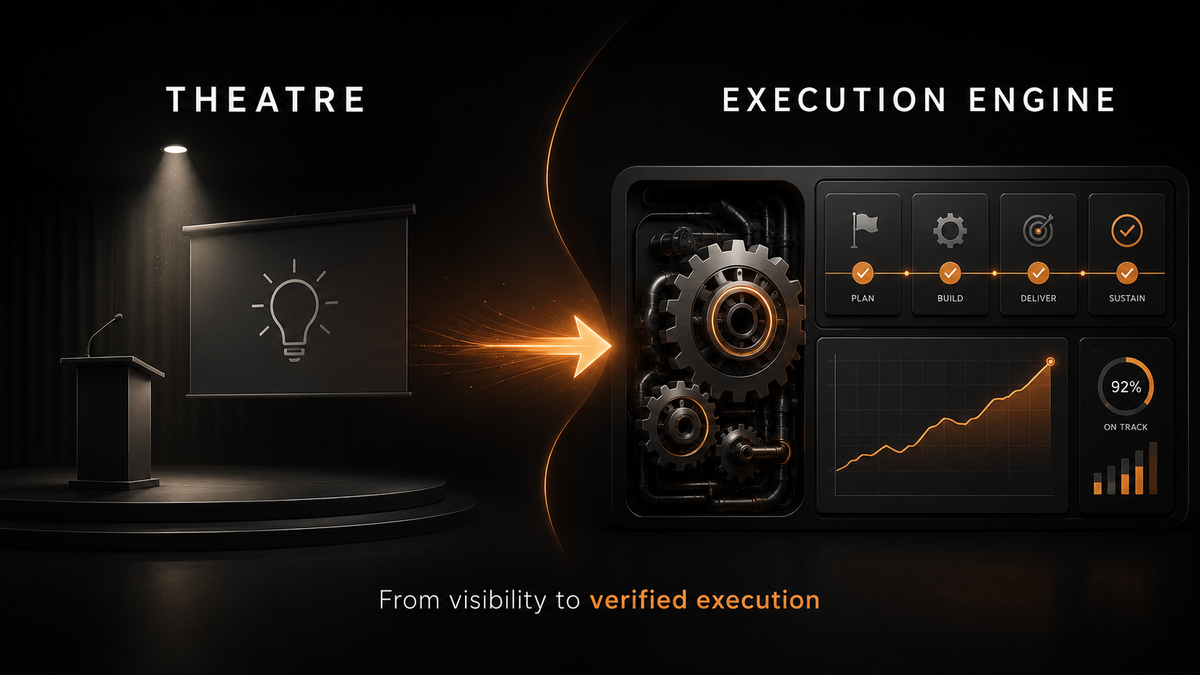

The UK and Europe run more accelerator programmes than ever — on a business model that pays everyone except the accelerator. Here is how an EC-powered ecosystem turns a cohort programme into a continuous execution engine: more value delivered, more startups helped, real recurring revenue, and mentors who finally get paid.
The model everyone copied. And nobody fixed.
The UK alone now hosts more than 500 accelerator programmes, with over £219 million deployed through Innovate UK since 2016. Across the UK, an estimated 19,600 firms pass through incubators and accelerators every year. Europe adds hundreds more programmes across every vertical from climate to fintech to deeptech.
And yet in 2025, The Entrepreneurs Network — the UK's think tank for entrepreneurship policy — warned that founders cannot even be sure their programme will still exist by the time they finish it. Their prescription: replace short-term, one-off grants with multi-year outcome-linked funding, because the current revenue base does not sustain the sector.
Read that again. The institutions built to make startups sustainable cannot sustain themselves.
Follow the money and the problem is obvious. Most UK and European accelerators run on three revenue legs, and every one of them wobbles:
– Sponsorships and grants. Renewed annually, cut first in a downturn, and increasingly conditional on ROI evidence the cohort model cannot produce. Anecdotes and demo-day photos no longer renew a corporate innovation budget.
– Equity stakes. Typically 5–10% for £50–100k invested. Real value — but locked for a decade, deep in the J-curve, and concentrated in a handful of outliers while the middle of the portfolio stalls.
– Programme fees. Charging pre-seed founders meaningful fees is self-defeating. The customers with the greatest need have the least cash.
Meanwhile, the delivery side runs on goodwill. Mentors are volunteers: no scoped deliverables, no acceptance criteria, no accountability, no compensation. The best operators drift away because unpaid advice does not survive contact with their calendar. And the generic advice that remains is being commoditised by AI in real time.
Then the programme ends at demo day. The moment graduates need execution most — post-raise, post-pivot, first hires, first revenue — the accelerator goes quiet, because the model has no mechanism to keep working with them.
Here is the frustrating part: the product works. Beauhurst's research shows accelerated UK companies are 44% more likely to raise equity, and raise at higher valuations. Accelerators create value. The model just never built the rails to capture it.
What an EC-powered ecosystem changes
Execution Capital does not replace your accelerator. It re-plumbs the economics underneath it. You keep the front office — brand, cohort pipeline, alumni network, sector focus, sponsor relationships. EC provides the back office: the platform, expert matching driven by GEM gap analysis, a compliant corporate structure with a dedicated investment vehicle, cash and VCI™ payment rails, milestone governance, NAV monitoring and Proof-of-Execution reporting.
Four things change on day one.
1. You add more value — because value-add becomes a delivery system
Advice becomes execution. Every engagement is a scoped Ticket: defined deliverable, acceptance criteria, timeline, milestone-gated settlement — delivered by senior fractional operators, not well-meaning volunteers. GEM maps each company's maturity gaps and matches the right expert to the right gap at the right stage. Grow Now, Pay Later finances both Tickets and retainers, so companies access senior CTOs, CFOs and GTM leads without burning the runway they don't have.
2. You help more startups — because the cohort becomes a continuum
Demo day stops being the finish line. Graduates keep executing inside your ecosystem for years, with support no longer capped by their bank balance. Your alumni network stops being a mailing list and becomes an active portfolio — and every verified milestone they ship becomes board-ready proof for your sponsors.
3. You make more money — because the ecosystem finally has a revenue engine
Every Ticket and financed retainer settled in your ecosystem carries a 20% platform transaction fee — 10% on the startup side, 10% on the expert side, charged on both the cash and VCI™ legs. Both sides pay because both sides gain: startups access senior execution financed against outcomes; experts access qualified deal flow, governed settlement and portfolio-level upside. You keep 50% of the total fee — the standard 50/50 split with EC — earned in cash and VCIs™. That is recurring revenue between exits, diversified beyond sponsors and grants, that compounds with the execution volume of your own portfolio.
4. You pay your mentors — because accountability is the payment mechanism
Experts are compensated on a blended cash and VCI™ basis, settled only on verified delivery. VCIs™ are issued at the ecosystem portfolio level — never on your companies' cap tables — so experts hold governed, portfolio-linked upside instead of worthless single-company promises. Senior operators show up, stay, and perform. Not because of goodwill. Because they are paid like professionals with skin in the portfolio.
Run the numbers yourself
We built the Operator ROI Calculator so you do not have to take any of this on faith. It models your setup and subscription costs against your share of the 20% transaction fee — 10% startup side plus 10% expert side — across a five-year horizon.
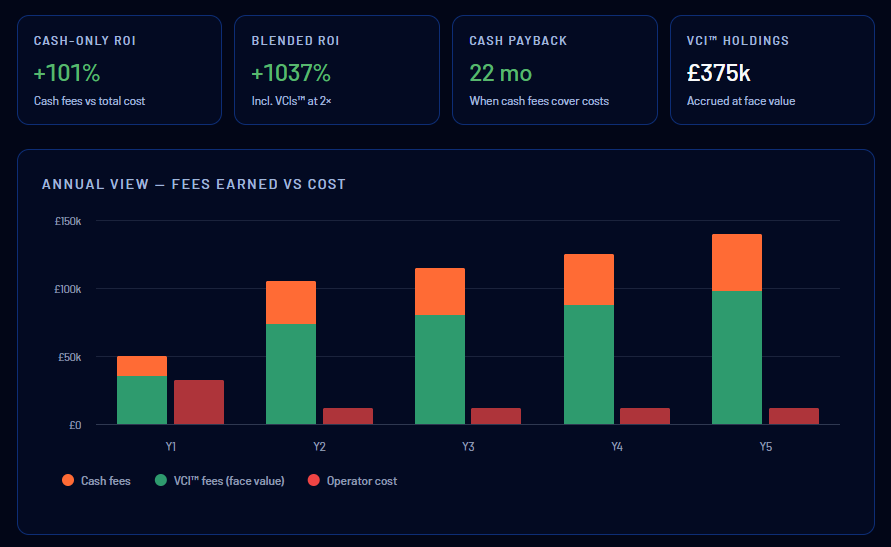
The default scenario is deliberately modest: 10 companies onboarded in year one, 10% annual growth in new onboardings, each company active for two years, averaging £50k of execution spend per year — Tickets and financed retainers combined. Over five years that produces:
– £5.35M in cumulative execution volume
– £1.07M in platform fees at 20%
– £535k as your 50% operator share — £161k in cash, £375k in VCIs™ at face value
– Cash payback in 22 months against £80k of total setup and subscription cost
– +101% cash-only ROI — before assigning any value to the VCIs™ at all
Model the VCI™ leg at a 2× multiple and blended ROI passes +1,000%. To be clear: VCIs™ carry venture-style, portfolio-linked risk. The calculator lets you model 0× to 4× precisely because it is a range, not a promise. The point stands on cash alone: the cash leg pays for the ecosystem, and everything in VCIs™ is upside on top.
The numbers are not a pitch. They are the bar.
Here is what most partnership pages will not tell you: we say no to most operator conversations.
We only launch EC-powered ecosystems with operators who can credibly hit the calculator's baseline — roughly ten qualified companies onboarded in year one, growing from there. That requires two things no platform can fake for you:
– Demonstrated high deal flow in a defined niche. A sector, stage or geography where you are already the obvious front door — not a generalist funnel hoping volume shows up.
– A robust, evidenced selection process. Execution financing only works on companies worth financing. Your filter is the underwriting.
Meet that bar, and the EC platform takes care of the value-add side entirely — matching, Ticket scoping, legal structure, settlement, governance, Proof-of-Execution — subject to your ecosystem bringing three assets to the table: a high-quality network of senior experts, engaged investors, and genuine market access for your companies. You supply selection and reach. We supply the execution infrastructure. Neither works alone.
Ten companies a year is a floor, not an ambition. If your deal flow is real, the model scales with it.
The next move
The cohort model had a fifteen-year run. It proved accelerated companies outperform — and proved the accelerator captures almost none of it. Sponsors want evidence. Mentors want compensation. Founders want execution, not advice. The economics were always going to have to change. Now they have.
Run the Operator ROI Calculator against your real pipeline. If your numbers clear the bar, apply as an Ecosystem Operator and we will run the economics against your portfolio — not a slider.
Execute First. Build Proof. Raise Later.
Sources: The Entrepreneurs Network (2025); Innovate UK; Beauhurst, Accelerating the UK; Universities UK; EC Operator ROI Calculator default scenario. Calculator outputs are directional modelling, not financial advice.
 Kevin Monserrat
 Kevin Monserrat