
Does it matter if your VC has never run a company?
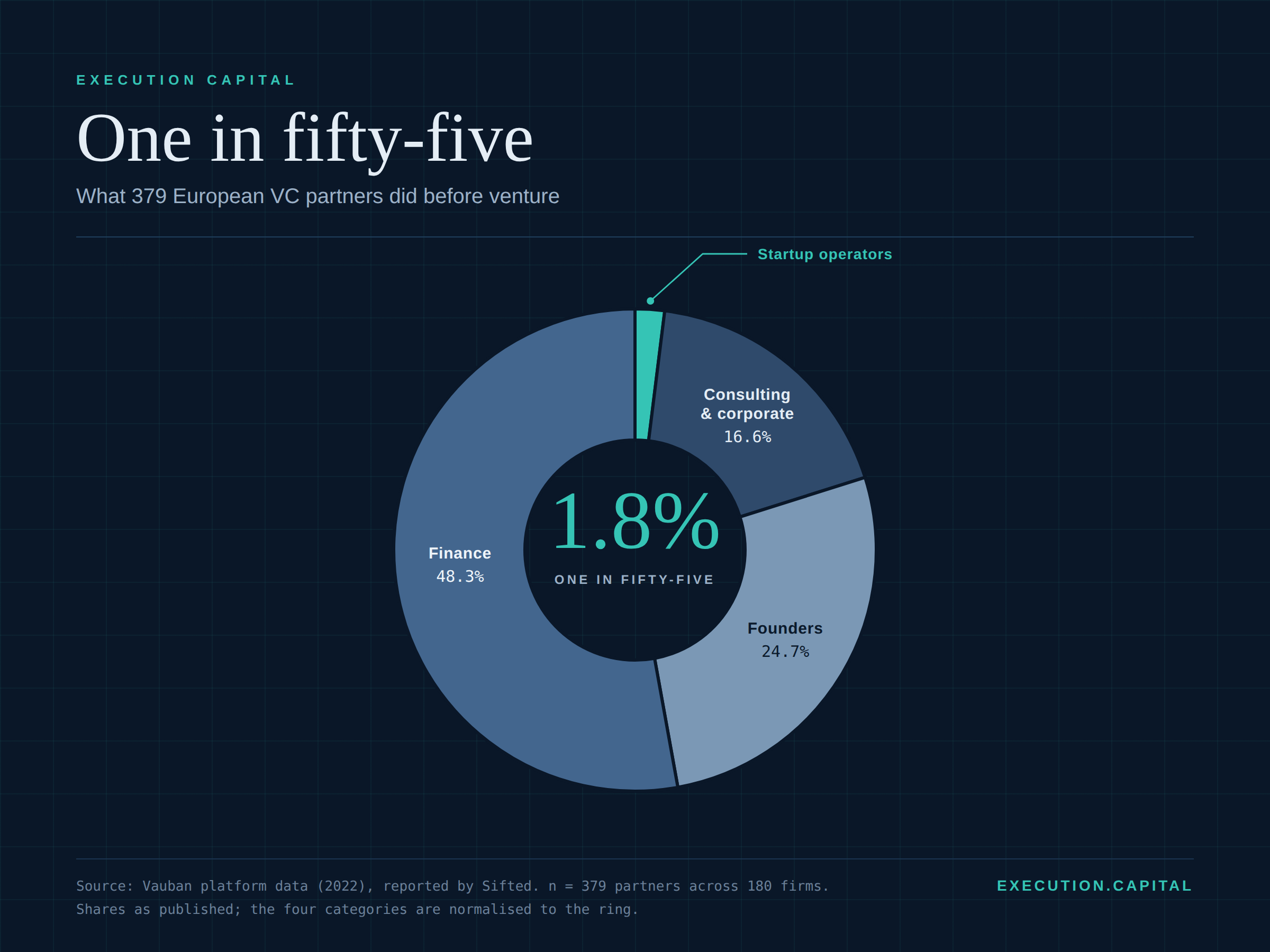
1.8% of European venture partners came from an operating role. The research on whether that changes anything is more surprising than either side expects.
Every founder has the same story about their investor.
He wanted to help. He genuinely did. He took the call on a Sunday. He made the intro. He sat in the board meeting and asked sharp questions about the burn.
Then the company hit the thing that was actually going to kill it. The go-to-market that had stopped working. The technical hire who had to be replaced. The pricing model that needed rebuilding in six weeks, by someone who had rebuilt one before.
And he had nothing.
Not because he didn't care. Because he had never done it.
Which raises a question the industry has been remarkably incurious about.
Does it actually matter?
It might not. Plenty of excellent investors have never operated anything. Plenty of brilliant operators have made dismal investors. It is entirely possible that the two skills are unrelated, and that the complaint is really just founders wanting a co-founder for free.
There is a number behind the question. Then there is an answer to it.
Both are worse than you think.
One in fifty-five
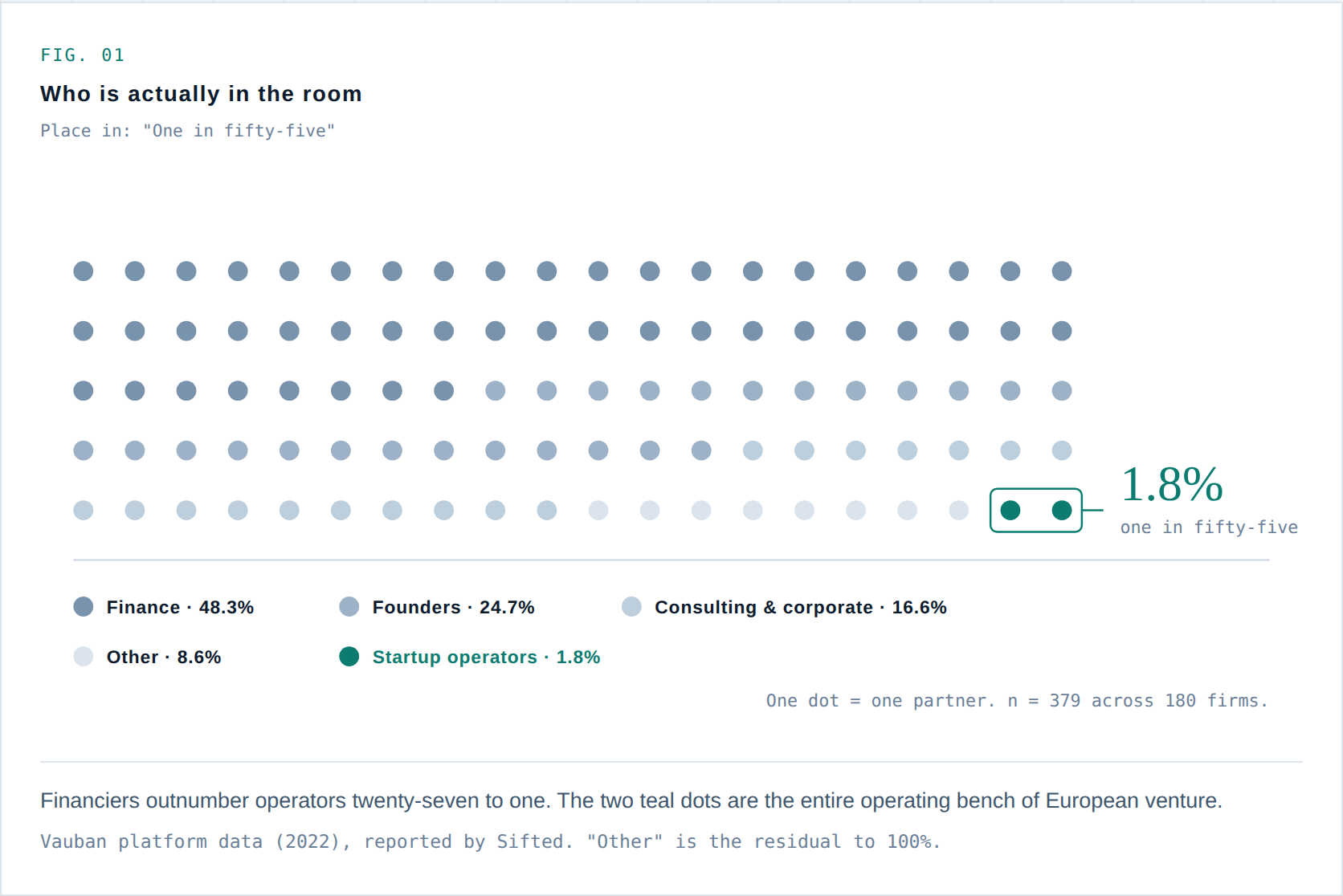
A study of 379 venture partners across 180 firms — roughly 40% UK, 40% rest of Europe, 20% rest of world — asked a simple question. What did you do before venture?
Finance: 48.3%. Founders: 24.7%. Consulting and senior corporate roles: 16.6%.
People who held an operating role inside a startup: 1.8%.
One in fifty-five. Financiers outnumber operators twenty-seven to one.
Now the caveats, because they matter and because you will hear them thrown back at you. The study is from 2022. It is one dataset. And it counts founders separately from operators, so someone who scaled their own company to two hundred people sits in the 24.7%, not the 1.8%. Take the number as directional rather than precise.
It survives the scrutiny. PitchBook cuts the same question at firm level and lands in the same place: roughly 8% of European VC firms are led by former operators, against about 50% in the US. A separate study of more than two thousand UK venture employees found consulting at 20%, finance at 18%, investment banking at a further 12% — and startups at 8%.
Three methodologies. Three samples. One shape.
European venture is staffed by people trained to price risk. It is now being asked to supply delivery. Those are different jobs, and nobody ever wrote the second one down.
Call it the Experience Gap.
Why it happened, and why it stays
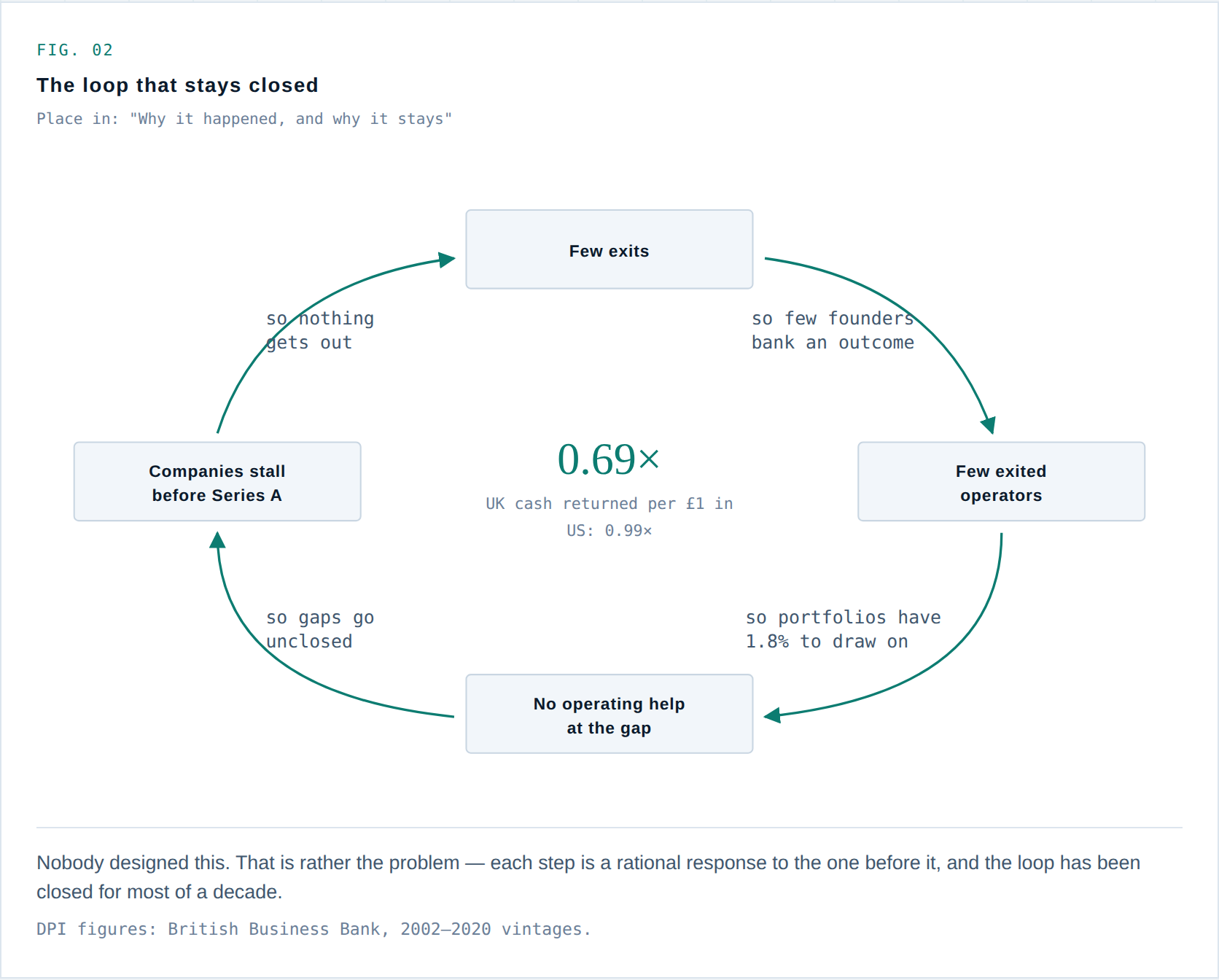
This is not a story about bad people. It is a story about a loop that closed.
Operator-investors come from somewhere. They come from founders and early employees who got out — who sold the company, banked something, and went looking for the next thing to do with what they learned.
Europe does not produce many of those.
Across 2002–2020 vintages, UK venture funds returned a pooled DPI of 0.69. US funds returned 0.99. DPI is the honest number — cash actually back in investors' hands, as opposed to what the spreadsheet says the portfolio is worth. On paper the two markets look close: 1.84 against 1.95. On cash, the UK has returned roughly two-thirds of what the US has.
For newer funds it barely registers. British Business Bank vintages from 2018 to 2023 sit at a DPI of 0.08. In a survey of 111 European venture firms, 56% had returned no capital to their investors at all in the preceding twelve months.
The routes out are closed and everyone knows it. 43% of European VCs name the absence of M&A routes as the single biggest barrier to deploying more capital. European listed tech is worth $1.7 trillion against $37 trillion in the US, spread across thirty-six exchanges rather than two. Listing candidates from 2025 and 2026 have quietly slipped to a notional 2027–28 window.
So: a market that does not produce exits does not produce exited founders. No exited founders, no operator-investors. No operator-investors, no operating help for the next generation — who then don't exit either.
The loop has been closed for most of a decade. And a generation of European partners has now invested through an entire fund cycle without once running an exit process, because exit capability is learned the same way everything else is. By doing it.
So does it matter?
The obvious answer is: hire founders, problem solved.
The research is more precise than that, and considerably less flattering to everyone involved.
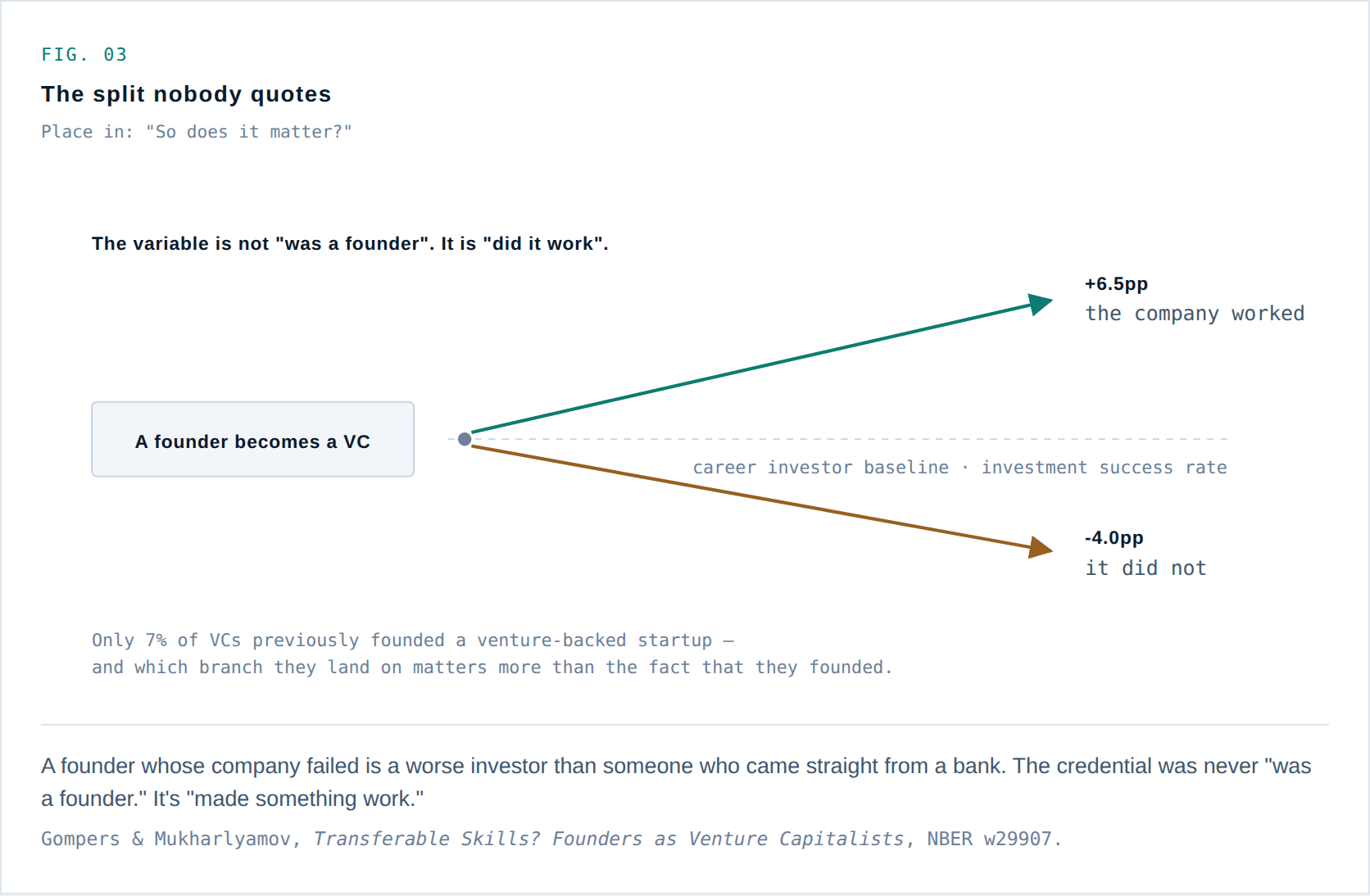
Gompers and Mukharlyamov studied what happens when founders become venture capitalists. Their finding splits cleanly in two.
Founders whose companies succeeded outperform career investors by 6.5 percentage points on investment success rate.
Founders whose companies failed underperform career investors by 4 percentage points.
Read the second line again. A founder whose startup didn't work is a worse investor than someone who came straight from a bank.
The mechanism is the part that should change how you think about this. Successful founder-investors do see better deals — but instrumental-variable analysis shows deal quality doesn't explain the whole gap. The outperformance comes from what they do after the money goes in.
Which means the qualification is not the biography. Starting something is not the credential. Making something work is.
So the answer to the question is yes — but not for the reason founders usually give when they complain about it. It isn't that investors who've never operated lack empathy, or don't understand the grind. It's narrower and more measurable than that. The advantage exists, it shows up after the money lands rather than in the deal selection, and it only appears in people who have actually made something work.
"Founder-friendly" is a marketing position. Demonstrated execution is a measurable one. The industry has spent a decade conflating them.
What founders actually receive
Ask the market.
In a survey of 500 UK founders and investors, 92% of investors described themselves as value-add.
61% of founders said they received less than was promised. 47% pointed at a lack of industry-specific knowledge. 33% said the investor had been dishonest about the expertise they held.
And 65% said the investor genuinely tried, and could not deliver.
Sit with the ratio for a second. Only a third allege dishonesty. Two-thirds are describing someone who showed up, meant it, and had nothing to give.
That is precisely what a 1.8% operator base predicts. It is not a motivation problem. It is a supply problem. The industry is not lying about wanting to help — it is under-equipped to help, and it has been telling itself otherwise for a decade.
What they do have
Now the other side of the ledger, because the argument so far is unfair, and unfair arguments don't survive contact.
An investor who came out of banking or consulting is not an empty suit. They can price a round. They can structure a deal that doesn't detonate at Series B. They can run a diligence process, read a data room properly, negotiate against someone who does this for a living, and — this one matters more than founders admit — actually sell a business when the moment arrives. Those are hard skills, and founders systematically undervalue them right up until the week they need them.
And there is something they have that is worth more than all of it.
The network.
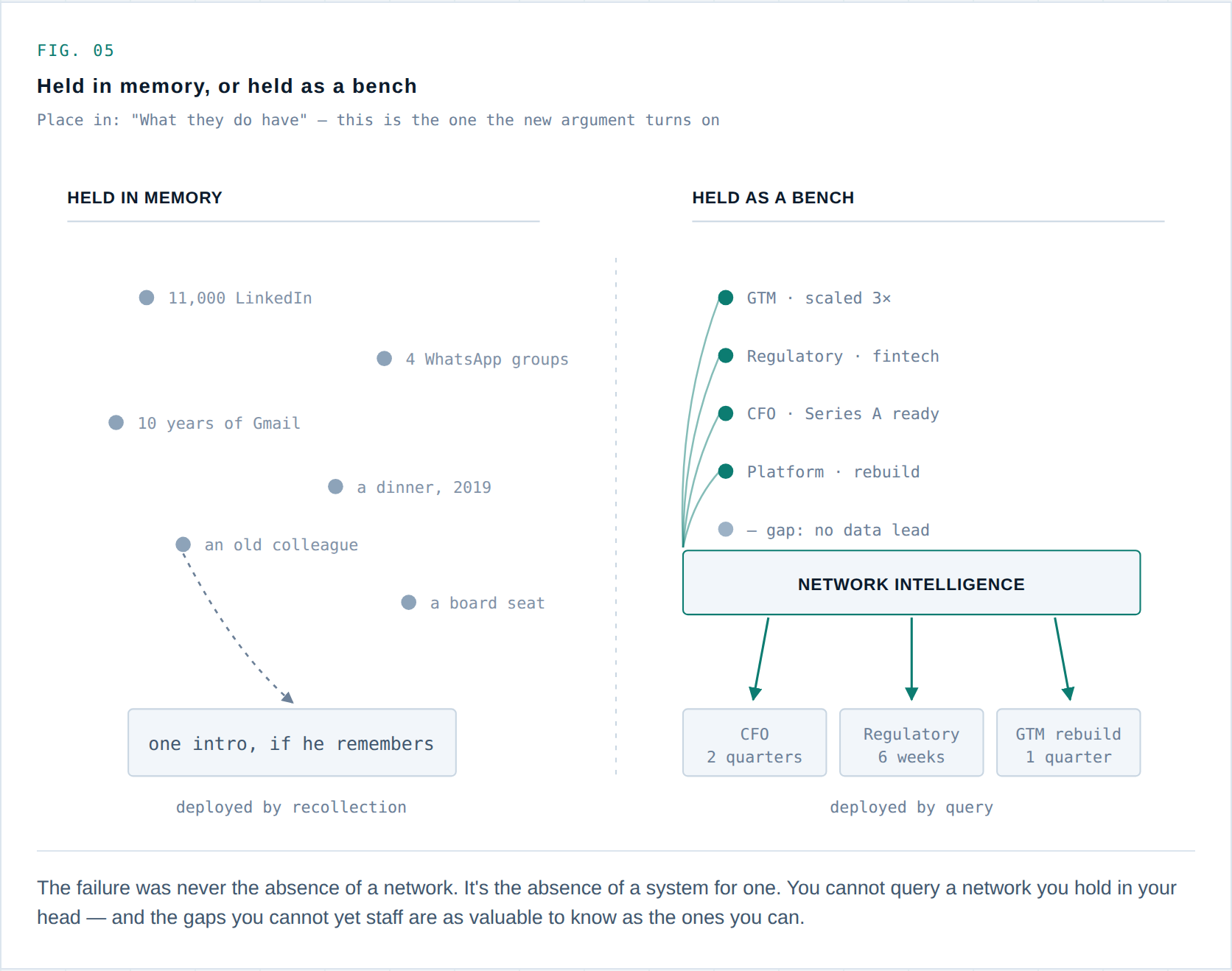
A partner's real balance sheet is not the fund. It's the two thousand people who will take their call. The ex-CRO who has scaled the exact motion you're trying to scale. The regulatory specialist who has already been through your approval. The three CTOs who have each made the architecture mistake you are about four weeks away from making. Twenty years of finance, consulting and boardrooms builds the single most valuable asset in this market, and it is not the money.
So here is the real question.
Where does that network live?
It lives in eleven thousand LinkedIn connections nobody has ever mapped. In four WhatsApp groups. In a decade of Gmail. In the memory of a dinner in 2019. It is unstructured, unqueryable, and held entirely in one person's head.
Which means it gets deployed by recollection. A founder raises a problem at a board meeting. If the partner happens to remember the right person, and the relationship happens to still be warm, and they happen to have the ten minutes to make the introduction properly rather than as a two-line forward — something useful happens.
Maybe a dozen times a year. Per partner. Across a portfolio of twenty-five companies.
That's the actual failure. Not the absence of a network. The absence of a system for one.
You cannot query a network you hold in your head. You cannot staff a portfolio from memory. And you certainly cannot know in advance which of your twenty-five companies has the gap that is going to kill it, or which of your eleven thousand contacts could close that gap in two quarters.
Their network is their net worth. Almost all of it is idle.
And the clock got worse at the same time
Here is where it stops being an industry story and starts being your problem.
In 2016, around 31% of seed companies reached a priced Series A within twenty-four months. The median gap between rounds was eighteen months.
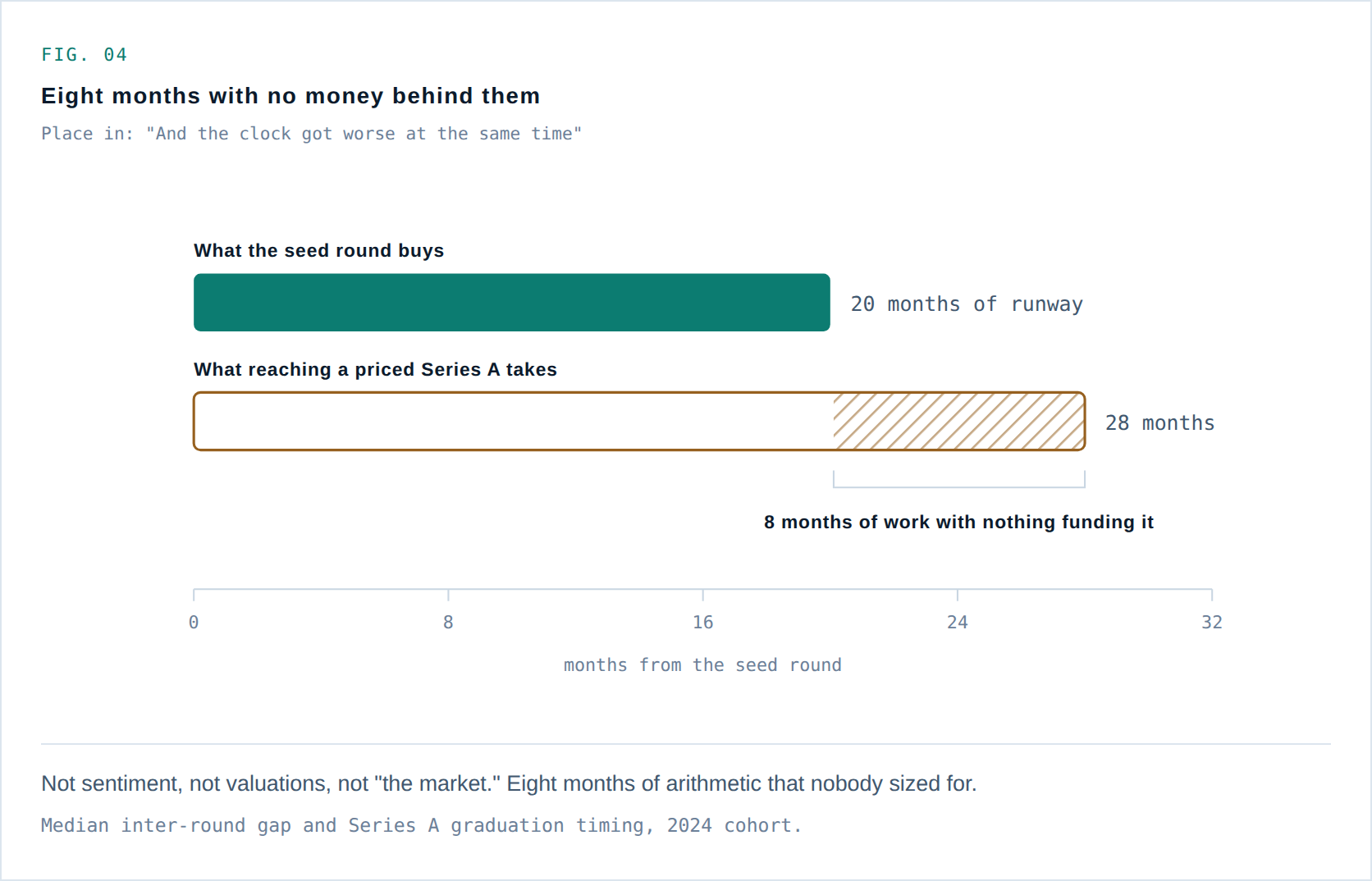
By the 2024 cohort, graduation is running at 15–18%, and the median gap has stretched to twenty-eight months.
The bar moved with the clock. In 2021 a Series A could be raised on team and narrative at $0–500k of ARR. The working benchmark today is $1–2m ARR, growing three times year on year, with net revenue retention above 100%.
A typical seed round buys about twenty months of runway. The work now takes twenty-eight.
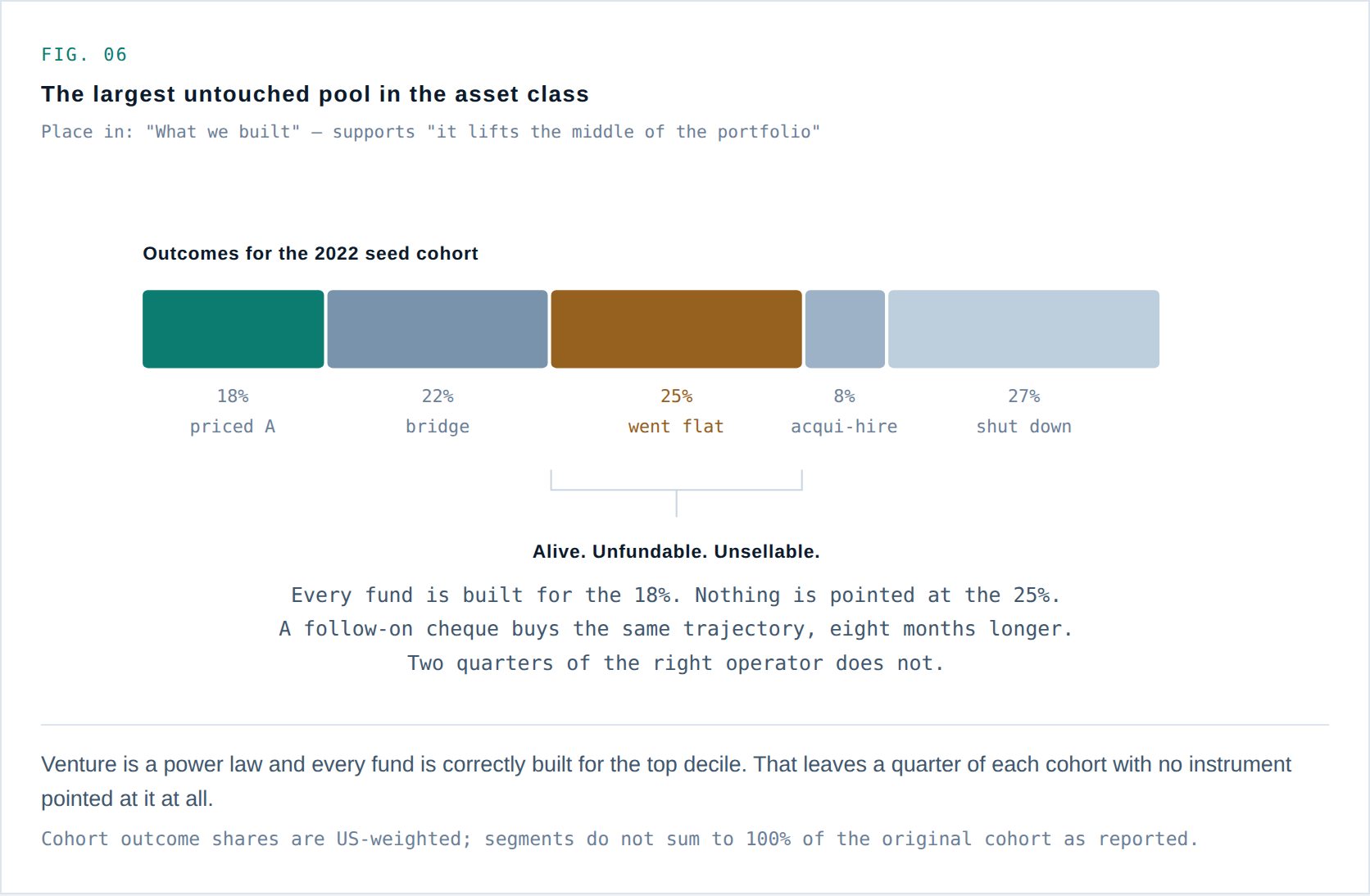
You can see the result in what happened to the 2022 cohort. Around 18% raised a priced Series A. Around 22% took a bridge or an extension. Around 27% shut down.
And around 25% went flat. Alive, unfundable, unsellable.
That quarter is the most misdiagnosed group in European technology. They do not have a capital problem. More money at their current level of proof buys the same trajectory, eight months longer. They have an execution problem — a product that needs finishing, a revenue engine that needs rebuilding, a go-to-market that needs a senior operator for two quarters.
Which is the one thing their investor base is 1.8% equipped to supply.
The constraint moved. Nothing else did.
Ten years ago the scarce input in a startup was capital. Hire the team, buy the runway, find the market.
Today, for a company sitting between seed and Series A, the scarce input is delivery. Not advice about delivery. Delivery — someone senior who has done the specific thing before, doing it, on a defined timeline.
Nothing in the industry's structure moved to match. The money still arrives as money. The help still arrives as opinion. And the distance between what a founder is handed and what a founder needs is now measured in eighteen months of runway they do not have.
None of this is an argument against venture capital. Capital is not the enemy and never was — a company that needs to raise should raise, and most eventually will.
It is an argument about sequence. Raising in order to buy time to look for proof is the expensive version. Building proof and then raising on it is the cheap one. That is a timing decision, not a funding decision, and it is very nearly the only variable in this entire picture that a founder still controls.
What we built
This is the problem Execution Capital exists to solve.
Tickets are scoped deliverables with acceptance criteria and milestone-gated settlement. Not a retainer. Not a board seat. A defined piece of work, delivered by a senior operator, against a definition of done that someone signs. No delivery, no settlement — which is the accountability the phrase "value-add" has never once carried.
GNPL — Grow Now, Pay Later — funds that work at roughly 30% cash and 70% VCI™. Venture Capital Interests are portfolio-level units. Ring-fenced. Mapped to economic rights. Not on the startup's cap table, and not a speculation.
Ecosystem Operators are the missing 1.8%. The people who have shipped, hired, missed a number and fixed it. Our structure pays them partly in economic upside for work delivered, rather than for time attended — which is the arrangement the funding market has never been able to offer them.
And Proof-of-Execution is what comes out the other side. In a market where realised returns have decoupled from paper valuations and nobody trusts a mark, delivered scope against stated acceptance criteria is the only credible unit left. It travels. To the founder, to the next round, to everyone downstream.
But the part that matters most for the argument above is the one nobody expects from an execution business.
Network intelligence. Every Ticket scoped, every bid placed, every milestone verified builds an execution graph — who ships on time, in which domain, at what cost, at which stage of maturity, and which gaps reliably predict a failed raise. A partner's contacts stop being a list of names and become a bench: searchable by capability, live on availability, honest about the gaps the ecosystem cannot yet staff.
The network stops being something you remember. It becomes something you can query.
That is not theory. Under its predecessor programme, the model activated more than 300 senior experts averaging 35 years of experience across 32 distinct domains — from regulatory directors to backend integrators. In one deployment, a company facing the standard 120-day search for a senior technical and leadership bench had one matched and working in days.
Three things follow, and this is what the model is built to do rather than a result we're claiming:
It flattens the J-curve. Proof arrives earlier when delivery is financed directly instead of funded out of burn. Earlier proof means earlier step-ups, and a shallower trough before them.
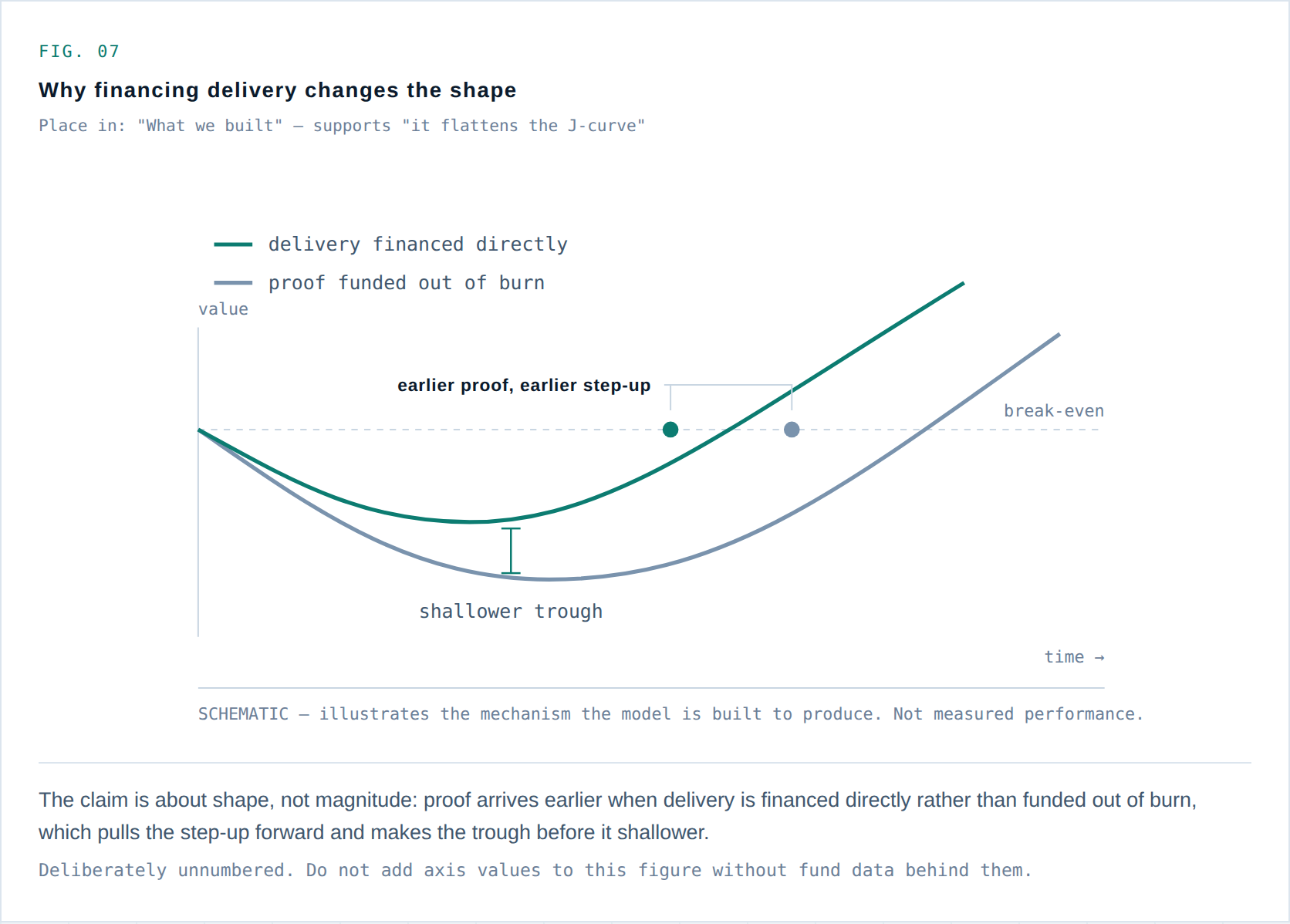
It lifts the middle of the portfolio. Venture is a power law and every fund is built for the top decile — which leaves the 25% that go flat as the largest untouched pool of value in the asset class. Those companies do not need another cheque. They need two quarters of the right operator, and until now there has been no mechanism to route one to them.
And it extends the runway to the round that matters. Not by cutting costs. By converting part of the cost of reaching Series A into VCI™ rather than cash — so that twenty-eight months of work can fit inside twenty months of money, and the company arrives at the raise in a position of strength rather than at the end of one.
So — does it matter if your VC has never run a company?
Less than founders think. And far more than the industry admits.
Less, because the missing line on his CV is not what costs you. A failed founder in the investor's chair is worse than a career financier, and the biography was never the point.
More, because the thing you actually need at month eighteen — someone senior who has done this specific thing before, doing it, on a deadline — is not something the funding market is structured to hand anyone.
And here is the part that should trouble the industry most.
He probably knows exactly the right person. They are somewhere in eleven thousand connections he has never had a reason to index. The capability was there the whole time. What was missing was any way to find it, price it, and put it to work.
Your investor wanted to help. Take him at his word — he did.
He just wasn't hired for the job you needed doing.
Someone should be.
Execute First. Build Proof. Raise Later.
The full research — 24 sources on the EU and UK venture market, its exit environment, and the composition of the people running it — is published in full and ungated at execution.capital/research.
 Kevin Monserrat
 Kevin Monserrat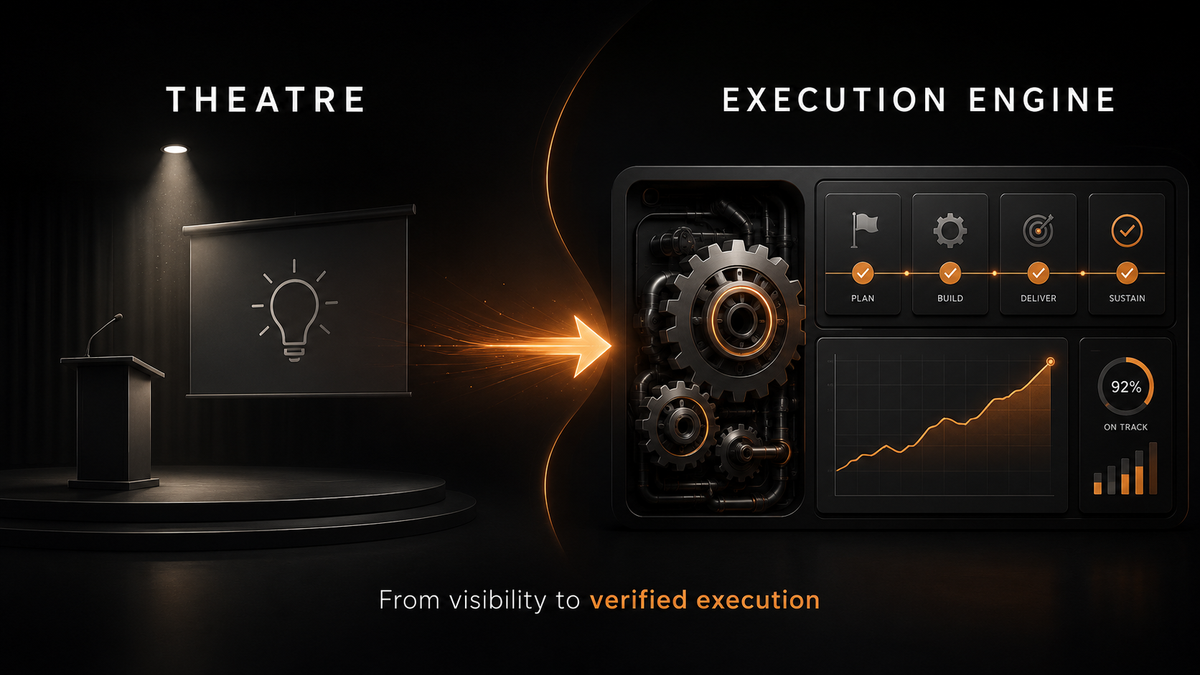
Source notes for the published version
- British Business Bank — UK Venture Capital Financial Returns 2025
- British Business Bank — Small Business Equity Tracker 2026
- European Central Bank — Exploring the investor landscape for venture capital (2026)
- Gompers & Mukharlyamov — Transferable Skills? Founders as Venture Capitalists (NBER w29907)
- Sifted — Why does Europe have so few startup operators-turned-VCs?
- Sifted — What did VCs do before they became VCs? (Vauban data, 379 partners)
- PitchBook — Why are so few of Europe's VCs former founders?
- Sifted — VCs don't add as much value as they think, say founders
- Sifted — 56% of European VCs haven't returned capital to their LPs
- Sifted — Why Europe's VCs are ditching the boardroom for startup life
- Sifted — 10 key findings from Atomico's State of European Tech 2025
- Sifted — How does Europe's VC scene compare to that in the US?
- Atomico — State of European Tech 2025
- Silicon Luxembourg — State of European Tech 2025 summary
- Quasa — $375 Billion Underfunded: Europe's fragmented, government-heavy VC
- Tech.eu — European tech in 2025: the data, the deals, and what comes next
- Tech.eu — More capital, fewer deals: what H1 2026 tells us
- PitchBook — How do US and European VC returns compare?
- PitchBook via Yahoo Finance — European VC fundraising is recovering. Not everyone is invited
- PitchBook — European VC pros expect fundraising challenges to squeeze emerging managers
- Coller Capital — Global Private Capital Barometer: Zombie Funds
- Obvio — UK VC Exits 2026: Why M&A and IPO Routes Are Blocked
- Value Add VC — The Series A Cliff: cohort graduation data
- Tech Funding News — Europe's VCaaS paradox: why top VCs reject platforms
Note on the cohort data: the graduation-rate series is US-weighted; no clean comparable UK/EU cohort series exists publicly. It is directionally consistent with the UK picture — seed deal counts fell 27% in 2025 — but should be presented as a market-wide trend rather than a European figure. If challenged, concede the point early; it costs nothing and the argument does not rest on it.