
What 9,700 European technology transactions reveal for investors marking portfolios, and founders preparing an exit or their next round.
|
AT A GLANCE ■
Price
has floored. Liquidity has not. The median private-tech revenue multiple
settled near 5.0x in 2025, but priced deal activity is 73% below its 2021
peak. ■
Entry
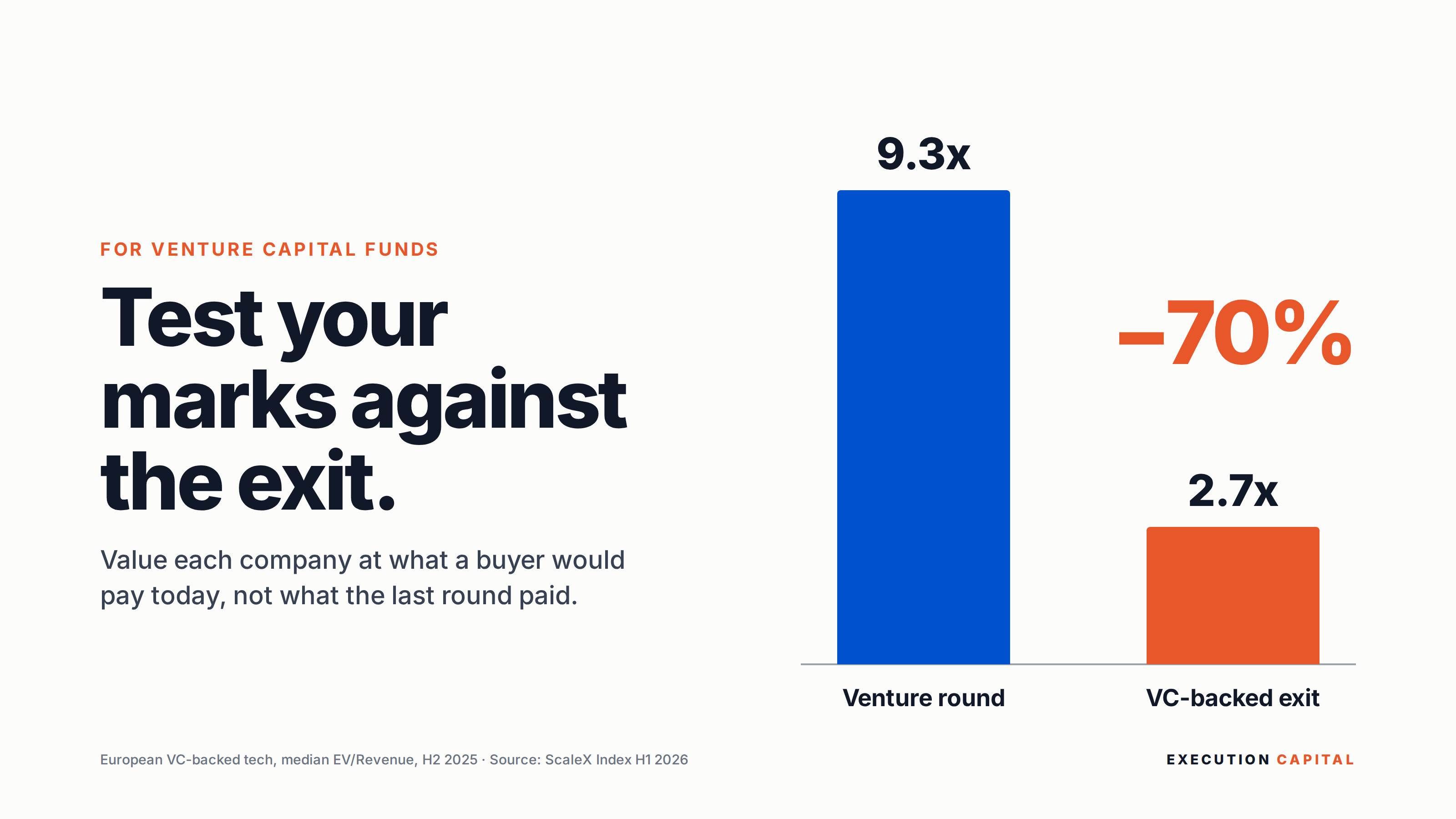
and exit disagree. Venture rounds priced revenue-generating companies at 9.3x
revenue. VC-backed exits cleared at 2.7x. ■
Proof
now sets the price. Break-even is a valuation valley. Exits, not rounds, will
confirm the recovery. |
The market stopped falling. It has not reopened.
After three years of repricing, the median European private-tech revenue multiple fell from 7.9x in H1 2022 and settled near 5.0x. Buyers and sellers finally negotiate against a benchmark that holds still.
The depth has not returned. ScaleX records 2,783 priced transactions in 2021 and 751 in 2025. In a market this thin, the median describes the companies that could clear a price, not the ones waiting to.
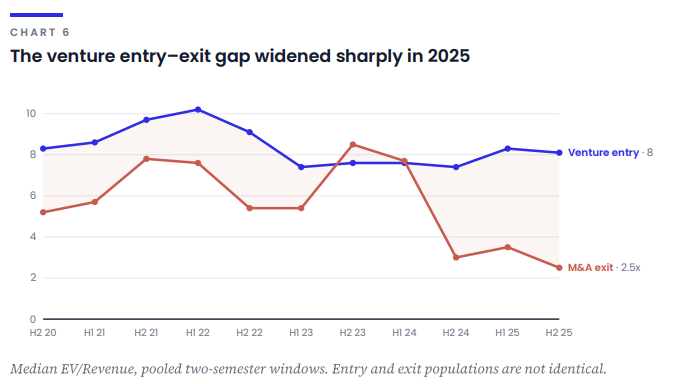
Venture is carrying a 70% entry–exit gap
In H2 2025, revenue-generating VC-backed companies raised at 9.3x revenue. Those that sold cleared at 2.7x. Europe produced just nineteen priced VC-backed exits in the latest window.
This is not a write-down formula. Exit samples include mature assets and forced sales; strip out the giants and the gap narrows to 45–60%. Still brutal.
EXHIBIT 1
Venture entry prices held while exit prices collapsed
Private equity took its medicine. Venture has not.
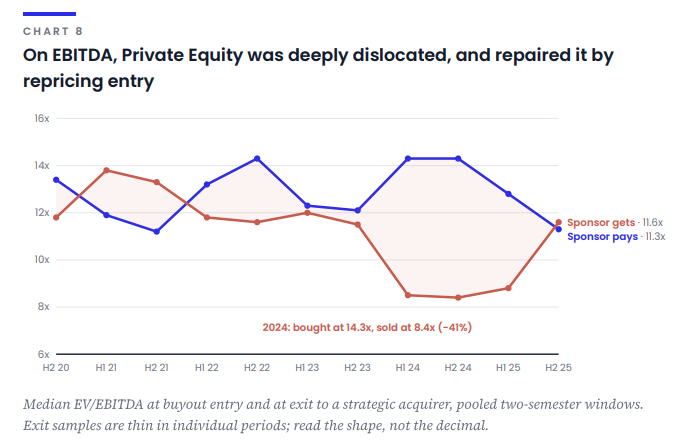
On EBITDA, sponsors bought at 14.3x in 2024 and sold to strategics at 8.4x, a 41% squeeze invisible in revenue multiples. By H2 2025 the spread had closed: 11.3x in, 11.6x out. Exits did not recover. Sponsors stopped overpaying.
The cost: with entry and exit at par, every euro of return must now come from EBITDA growth and debt paydown.
EXHIBIT 2
Buyout repaired its arithmetic by repricing entry, not exit
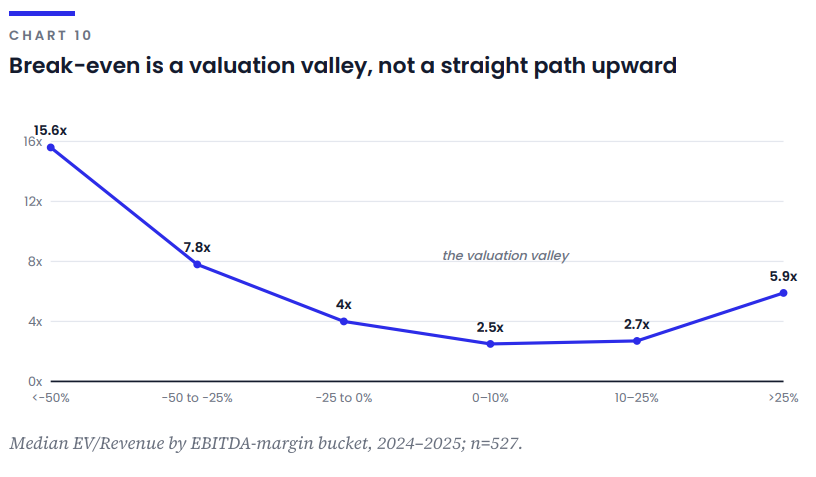
Break-even is the most expensive place to stand
Heavy burners clear at 15.6x revenue. At 0–10% EBITDA margin, the multiple bottoms out at 2.5x. The market withdraws the growth premium before it grants the quality premium. Proof also narrows the range: loss-making deals span 4.2x–22.0x; profitable ones, 1.6x–6.9x.
EXHIBIT 3
Crossing into thin profitability can cost most of the multiple
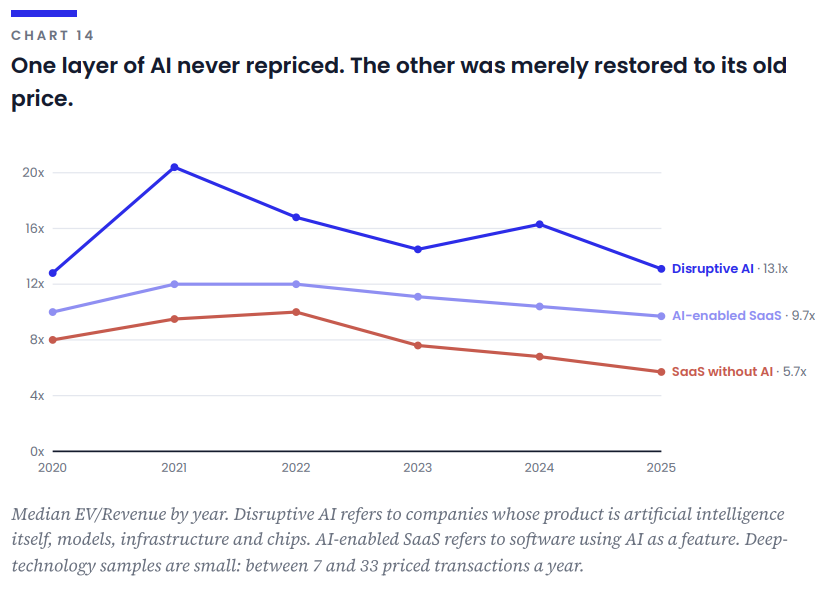
AI: scarcity versus relabelling
Companies building AI itself trade at 13.1x. AI-enabled SaaS sits at 9.7x, roughly what ordinary SaaS fetched at the 2021 peak. The label has restored old multiples more often than it has created new ones. Neither premium has been tested by exits.
EXHIBIT 4
Only the AI infrastructure layer escaped the correction
The exit signal is turning
Entry multiples lead exits by 12–18 months. Entry is up 13% over twelve months; listed tech is up 7%. Exits sit at 2.5x, deeply compressed. ScaleX’s Exit Tape points to higher exit prices over the next 12–18 months, having called direction correctly in six of eight semesters.
EXHIBIT 5
Leading indicators have turned; exit prices have not yet followed
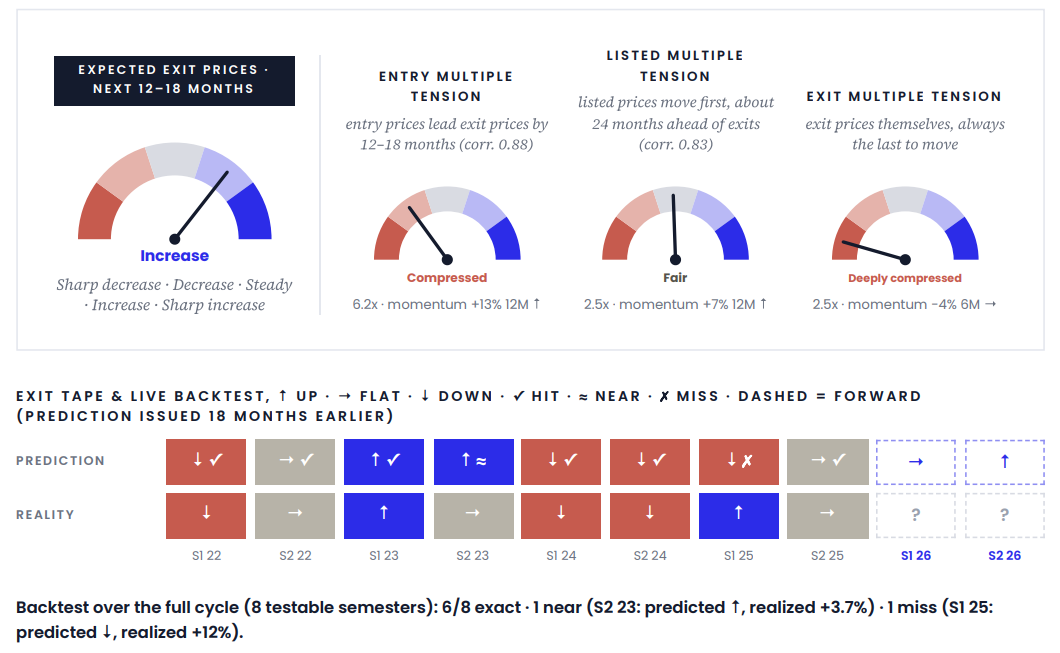
Source: ScaleX Index, European Tech Market Weather H1 2026 (transactions through H2 2025). Directional outlook, not a level forecast or investment advice.
What leaders should do now
■ VCs: Mark to the exit, not the last round. Rounds priced at 20–50x gave back 28% at the next raise.
■ PE: Underwrite on earnings growth alone. There is no multiple expansion left to borrow.
■ Founders raising: Cross break-even fast and visibly. Show that lower burn bought operating leverage, not a smaller business.
■ Founders exiting: Don't pick a margin. Pick your buyer, then work back to the numbers that buyer pays for.
- Selling to a trade buyer on strategic value: you can sell before the crossing, while the growth story is still priced in. Just sell to a buyer who needs you, not because your cash is running out.
- Selling to PE, or keeping every buyer in play: get through break-even to real margins (above 20–25%) with growth still running. That brings back the multiple (5.9x revenue in the report) and opens EBITDA-based buyers.
- Either way, don't sell in the valley. It only costs you if you raise or sell while sitting at 0–10% margin.
Exits, not rounds, will write the next cycle. The companies that win it will have built the proof before they needed the price.
Data: ScaleX Invest, ScaleX Index – European Tech Market Weather, H1 2026. Medians of disclosed transactions only; figures describe the observable market and should not be applied mechanically to any company or portfolio. Nothing in this article is investment advice.