
The Startup Dilemma: Why Founders Are Forced to Choose—and How Execution Capital Breaks the Rule
There's a worn principle that every founder encounters, usually scrawled on a whiteboard or muttered by a battle-scarred advisor:
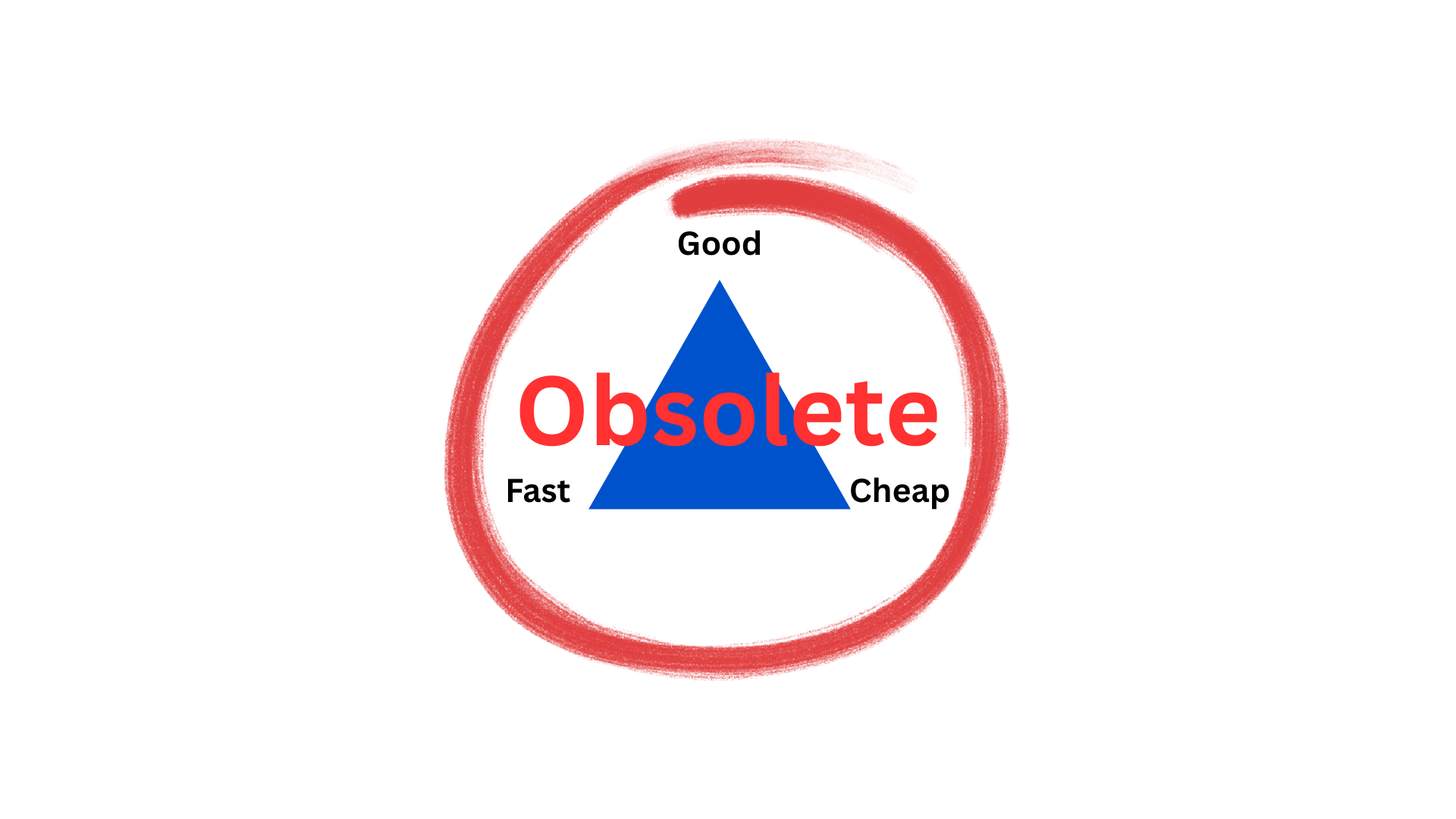
FAST — CHEAP — GOOD. Pick two.
It's treated like gospel. An immutable law of business physics. The Iron Triangle that governs every startup decision from hiring to product development.
But here's what nobody tells you: this triangle isn't natural law. It's structural failure. And it's been quietly suffocating promising companies for decades.
Why the Triangle Exists: Three Interlocking Traps
Trap 1: The Cash Starvation Engine
Early-stage companies operate in a state of manufactured scarcity. You need world-class product leadership to validate your concept, but senior product experts command £150k+ salaries. You need rapid iteration to find product-market fit, but speed requires burning through cash reserves.
The math is unforgiving: a typical pre-seed company with £200k in the bank can afford maybe six months of a senior team—or twelve months of junior execution. Neither timeline is enough.
So founders compromise. They hire eager but inexperienced talent. They outsource critical work to the lowest bidder. They personally attempt every role, spreading themselves impossibly thin.
The triangle forces its first sacrifice: quality.
Trap 2: The Expert Compensation Paradox
Senior operators—the fractional CTOs, the growth strategists, the regulatory specialists, the CFOs who actually know how to navigate complex problems—won't work for vague and illiquid equity promises anymore. They've watched too many cap tables get diluted into irrelevance. They've seen too many startups fold before their shares meant anything.
So they demand cash. Reasonable cash. Market-rate cash.
Which most early-stage founders simply don't have.
This creates the second forced choice:
- Pay full freight and burn through runway in weeks (fast + good = expensive)
- Negotiate deferred payment and wait months for engagement (good + cheap = slow)
- Settle for whoever you can afford (fast + cheap = disaster)
The triangle extracts its second toll: speed or affordability, never both.
Trap 3: The Traction Catch-22
Here's venture capital's cruelest irony: investors want proof before providing capital, but meaningful proof requires the very resources that capital would unlock.
In the age of AI, you need traction to raise. You need money to build traction.
The traditional solution? Bootstrap. Grind. Move slowly. Ship mediocre MVPs. Hope that "good enough" creates enough signal to attract investment before the bank account hits zero.
Founders trapped in this loop face the triangle's worst configuration:
- Slow execution (can't afford speed)
- Compromised quality (can't afford expertise)
- Dwindling cash (burning what little exists)
The triangle's final extraction: founders bleed out before they can prove viability.
The Uncomfortable Truth Nobody States
This isn't about founder incompetence or market dynamics or "just how startups work."
The Fast-Cheap-Good triangle exists because the infrastructure for early-stage execution is fundamentally broken.
Traditional venture capital provides money but not execution support. Consultants provide expertise but demand cash. Accelerators provide advice but rarely hands-on delivery. Incubators provide space but not senior talent.
The entire system forces artificial trade-offs because no mechanism exists to efficiently convert equity into execution at the moment founders need it most.
Until now.
How Execution Capital Dismantles the Triangle
Execution Capital doesn't sidestep the triangle through clever positioning or marginal optimization. It redesigns the foundational mechanics that created the dilemma in the first place.
The innovation is structural: instead of forcing founders to pay experts in either full cash (unaffordable) or pure equity (unappealing), EC introduces a hybrid model where startups receive a Grow-Now-Pay-Later execution budget—~30% cash, ~70% SPV Units (GPUs) backed by portfolio equity and/or future cash flows.
This seemingly simple shift detonates the entire triangle. Here's how:
Breakthrough 1: FAST Becomes Structurally Viable
Traditional models create delay at every step. Founders must:
- Raise sufficient capital (months)
- Budget for headcount (weeks)
- Recruit specialized talent (months)
- Negotiate equity and terms (weeks)
- Wait for availability (months)
By the time execution begins, the market has shifted, or the competitor has shipped.
ExeCap collapses this timeline to days, not quarters:
Senior experts join immediately because compensation is guaranteed—part cash (immediate liquidity), part GPUs (portfolio upside), and tied to milestone-based FlowShare agreements that activate only when work ships.
No fundraising cycle. No hiring committees. No negotiating employment contracts.
A pilot with Sime Clinical AI and 7 other startups demonstrated how the platform matched experts in March and enabled them to deliver work through June 2020, achieving what conventional recruitment would have taken 120 days to accomplish in a fraction of the time.
Speed is no longer purchased at the cost of cash reserves. It's unlocked through structural efficiency.
Breakthrough 2: GOOD Becomes Contractually Enforced
The quality problem in startups stems from misaligned incentives. Traditional arrangements pay for:
- Time (consulting retainers)
- Advice (mentorship programs)
- Promises (equity grants)
None of these guarantees shipped, verified work.
ExeCap flips the model: experts earn the bulk of their compensation through GPUs that convert to real value only when:
- Milestones are defined and agreed
- Work is delivered and verified
- Startups hit revenue gates
If an expert doesn't deliver? The founder pays minimal cash and loses nothing from unspent GPUs (which burn back into equity).
Quality isn't hoped for—it's structurally mandated. The platform's milestone-gated system ensures experts deliver results, not just meetings, with success measured by shipped milestones rather than hours logged.
Breakthrough 3: CHEAP Becomes Cash-Efficient by Design
"Cheap" has always been a misleading word. Founders don't actually want cheap—they want cash-efficient. They want to preserve the runway while accessing the expertise that creates real value.
ExeCap makes this possible by shifting 70% of expert compensation from immediate cash burn to future-linked GPUs.
The math is transformative:
Traditional model:
£100k of expert work = £100k cash burn immediately
Runway impact: -£100k
Execution Capital model example:
£100k of expert work for 1% equity = £30k cash + £70k GPUs
Runway impact: -£30k (immediate upon invoice)
The result? Founders can build with approximately 70% less cash than traditional models would require, extending runway by months while accessing the same or more senior expertise.
No debt spiral. No fixed overhead crushing the company. Just aligned incentives where everyone wins when the startup succeeds.
What This Means in Practice
For Founders: The End of Compromises
Stop choosing between speed, quality, and capital efficiency. The platform delivers all three through a single system: immediate expert access, milestone-based quality assurance, and up to 70% reduced cash burn.
You don't sacrifice runway to move fast. You don't sacrifice quality to preserve cash. You don't sacrifice speed while waiting for investment.
The triangle collapses because the structural constraints that created it no longer exist.
For Experts: Portfolio-Building, Not Hour-Trading
Senior operators stop trading hours for money and start building diversified portfolios. The pilot showed over 300 experts participating, building portfolios across ten startups investments rather than being locked into single consulting engagements.
You earn immediate cash (30%) for liquidity while accumulating GPUs across 5, 10, 15 companies. When those startups exit or generate distributions, you participate in the upside—not just once, but across an entire portfolio.
Risk is diversified. Upside is multiplied. Incentives are aligned with startup success, not billable hours.
For Ecosystem Builders: Sustainable Infrastructure That Pays for Itself
Accelerators, incubators, universities, VCs, and venture studios stop depending on one-off grants or hoping for distant equity exits. They generate continuous revenue through transaction fees, membership models, and distribution rights from their SPV portfolios—without raising traditional funds.
The economics transform fundamentally:
Instead of waiting years for portfolio exits, operators blend near-term cash flow (from transaction fees and milestones) with long-term equity upside. The system pays for itself through activity, not hope.
Instead of ad-hoc mentor sessions that extract value without compensation, operators deliver structured, ongoing execution support that compounds their influence—and their returns.
Instead of choosing between immediate revenue or portfolio value, they get both: cash flow today funds deeper engagement tomorrow, which extends portfolio runway and increases terminal enterprise value.
The platform provides everything needed: dedicated investment vehicles, legal templates, expert marketplaces, and automated settlement—all as turnkey infrastructure.
Launch a functioning ecosystem in weeks, not years. Generate sustainable revenue from network activity. Build real value without becoming a fund manager.
More importantly: increase your profitable influence across every company in your portfolio. The better they execute, the more the system generates—for everyone.
The Structural Revolution
The Fast-Cheap-Good triangle wasn't enforced by natural law or market forces. It was enforced by infrastructure absence.
No mechanism existed to:
- Convert equity into immediate execution
- Align expert incentives with long-term outcomes
- Preserve founder cash while accessing senior talent
- Create sustainable economics for ecosystem builders
So founders were forced into impossible trade-offs, experts worked for suboptimal terms, and ecosystem builders struggled for sustainability.
Execution Capital doesn't hack around these constraints. It rebuilds the foundation on which early-stage execution happens.
The result is a world where:
- Founders access world-class expertise immediately, without burning cash reserves
- Experts build portfolio exposure across multiple high-potential companies
- Ecosystems generate continuous value from network effects
- Growth happens through execution, not speculation
The Future: Systems, Not Triangles
The Fast-Cheap-Good triangle had its era. It described real constraints in a world where early-stage infrastructure was fragmented, misaligned, and capital-inefficient.
But structures aren't permanent. They're replaceable.
Execution Capital replaces the triangle with something fundamentally different: an execution system where speed, quality, and capital efficiency aren't trade-offs but integrated outcomes of aligned incentives and efficient infrastructure.
The triangle forced founders to sacrifice. The system enables them to execute.
The triangle extracted compromises. The system creates compounds.
The triangle belonged to the era of scarcity. Execution Capital belongs to the movement of execution finance—where value flows to contribution, where ecosystems become sustainable, and where 90% of founders who don't fit the narrow VC template finally have infrastructure built for them.
The choice is no longer "pick two."
The choice is whether to keep accepting artificial constraints—or to adopt infrastructure designed for a different outcome entirely.
The triangle had its time. Execution has its system.
Join the conversation on Linkedin