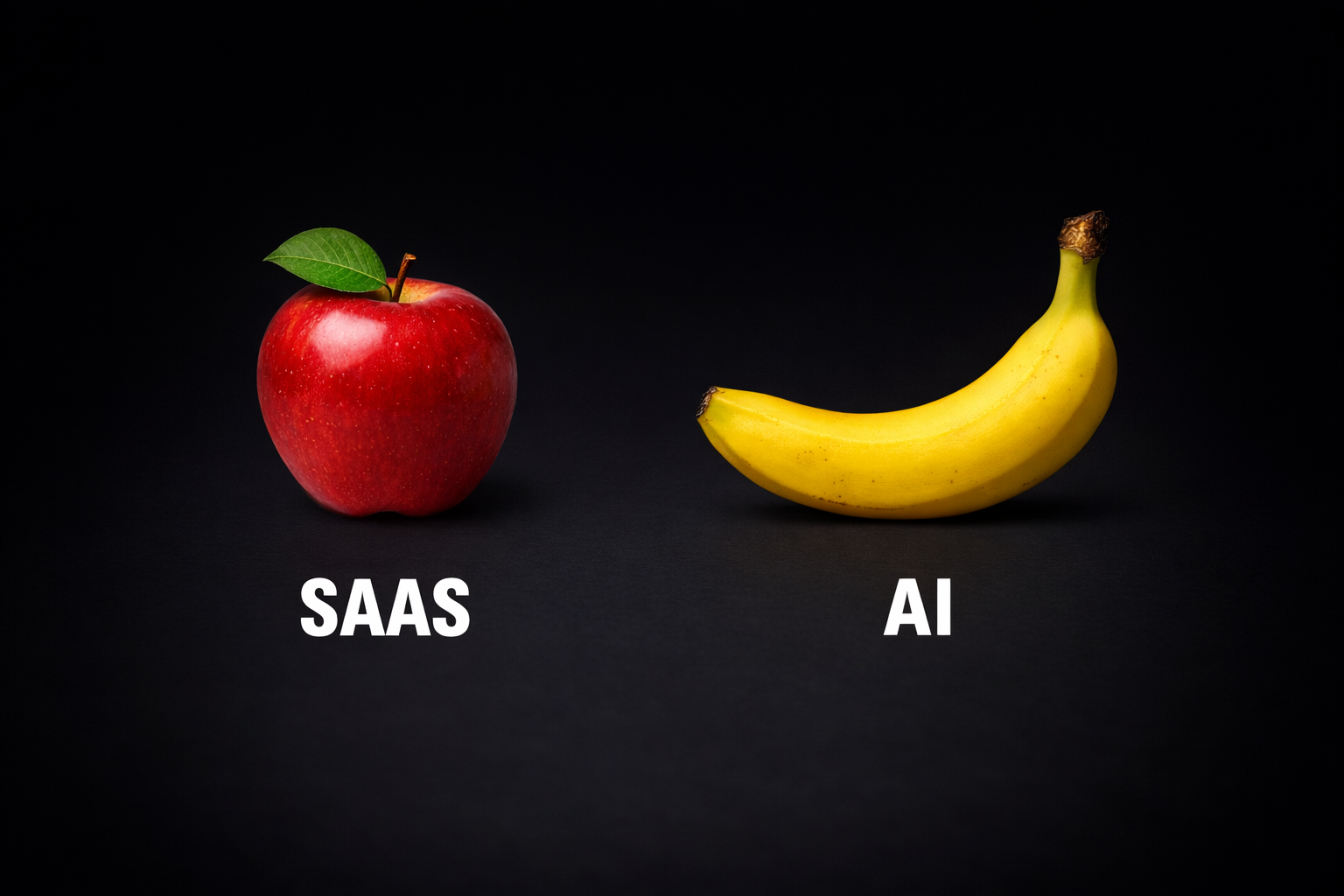

An AI startup isn’t a SaaS startup. Are you prepared?
Last month an AI startup team I know spent $50,000 on AI compute.
Four people. One month.
That number isn’t shocking anymore — not if you’ve seen what “real usage” looks like.
What’s shocking is what the invoice means.
Because most of us built our investing instincts on one beautiful SaaS promise:
Build the product once. Sell it forever. Marginal cost tends to zero.
That promise shaped everything: ARR multiples, efficient growth, land-and-expand, the entire religion of gross margin.
Now AI is quietly rewriting the rules.
In many AI-native products, the value isn’t something you ship.
It’s something you produce — again and again — every time the customer clicks.
Every workflow burns compute.
Every answer costs tokens.
Every “help me think” moment has a bill attached.
And that changes the business you’re actually running.
The uncomfortable truth: many AI companies are not software economics by default
They’re not doomed. They’re not “bad businesses.”
But they are metered services unless they deliberately evolve into something better.
If you want a metaphor that sticks, AI looks less like classic SaaS and more like a kitchen:
- Every customer request is a plate leaving the pass.
- Every plate has ingredient cost.
- A packed house can still lose money.
- The winners obsess over two things at once: the menu and the margins.
That’s the shift investors need to internalise.
What’s materially different vs SaaS
1) Gross margin becomes a first-class product constraint
In SaaS, finance often feels downstream: price, CAC, churn, scale.
In AI, the product is the cost structure.
A few decisions can double your COGS overnight:
- long prompts,
- huge context windows,
- agentic loops,
- repeated tool calls,
- using the most expensive model for every request.
Investors should stop treating margin as something that arrives later.
In AI, margin is something you design.
2) The unit of value must be defined — or you can’t price safely
SaaS could hide behind seats and “unlimited usage” because service cost was relatively stable.
AI can’t.
The winning AI companies define a unit:
- “per report generated”
- “per claim processed”
- “per customer ticket resolved”
- “per compliance check completed”
Once you have a unit, you can control the kitchen:
- measure cost per unit,
- cap runaway usage,
- price with confidence,
- improve unit cost over time.
No unit = vibes. And vibes don’t scale.
3) Scale doesn’t automatically improve margins
SaaS investors are used to scale improving margins by spreading fixed costs.
AI scale can do the opposite: it can simply multiply your bill.
So the question becomes:
Can this team reduce cost per outcome faster than usage grows?
That’s the new gross margin story.
What does this mean for investors?
It means your diligence needs one extra muscle:
Underwrite the margin engine, not just the product vision
Ask founders:
- “Do you know your cost per outcome?”
- “Which customers are unprofitable right now?”
- “What are your cost drivers?”
- “What are your guardrails?”
- “What is your plan to make intelligence cheaper inside your product over time?”
The best teams will answer crisply and show a dashboard.
The weaker teams will say:
- “We’ll optimise later.”
- “Model prices will come down.”
- “We don’t track tokens per customer.”
In 2026, that’s not a small gap. It’s existential.
Does this make CFOs more valuable in AI companies?
Yes — because the finance function stops being a scoreboard and starts being part of the product strategy.
A great AI CFO (or finance leader) doesn’t just close books.
They build:
- cost attribution by customer and feature,
- budgets and alerts,
- pricing guardrails,
- forecasting based on usage drivers,
- vendor risk strategy.
In SaaS, CFOs protect the P&L.
In AI, CFOs help design the economic machine.
And when done well, that machine becomes a moat.
The simple investor test
Here’s the one question I’d use to detect whether an AI startup understands what business they’re in:
“Does your next customer have predictable positive contribution margin?”
Not “does it cost money to serve them?” (everything does).
But: can you predict it, control it, and improve it?
If yes, you’re looking at an AI company that can compound.
If no, you’re not investing in software economics.
You’re funding a kitchen with no menu engineering — and the invoice will eventually decide the outcome.
Last month an AI startup team I know spent $50,000 on AI compute.
Four people. One month.
That number isn’t shocking anymore — not if you’ve seen what “real usage” looks like.
What’s shocking is what the invoice means.
Because most of us built our investing instincts on one beautiful SaaS promise:
Build the product once. Sell it forever. Marginal cost tends to zero.
That promise shaped everything: ARR multiples, efficient growth, land-and-expand, the entire religion of gross margin.
Now AI is quietly rewriting the rules.
In many AI-native products, the value isn’t something you ship.
It’s something you produce — again and again — every time the customer clicks.
Every workflow burns compute.
Every answer costs tokens.
Every “help me think” moment has a bill attached.
And that changes the business you’re actually running.
The uncomfortable truth: many AI companies are not software economics by default
They’re not doomed. They’re not “bad businesses.”
But they are metered services unless they deliberately evolve into something better.
If you want a metaphor that sticks, AI looks less like classic SaaS and more like a kitchen:
- Every customer request is a plate leaving the pass.
- Every plate has an ingredient cost.
- A packed house can still lose money.
- The winners obsess over two things at once: the menu and the margins.
That’s the shift investors need to internalise.
What’s materially different vs SaaS
1) Gross margin becomes a first-class product constraint
In SaaS, finance often feels downstream: price, CAC, churn, scale.
In AI, the product is the cost structure.
A few decisions can double your COGS overnight:
- long prompts,
- huge context windows,
- agentic loops,
- repeated tool calls,
- using the most expensive model for every request.
Investors should stop treating margin as something that arrives later.
In AI, margin is something you design.
2) The unit of value must be defined — or you can’t price safely
SaaS could hide behind seats and “unlimited usage” because the service cost was relatively stable.
AI can’t.
The winning AI companies define a unit:
- “per report generated”
- “per claim processed.”
- “per customer ticket resolved.”
- “per compliance check completed.”
Once you have a unit, you can control the kitchen:
- measure cost per unit,
- cap runaway usage,
- price with confidence,
- improve unit cost over time.
No unit = vibes. And vibes don’t scale.
3) Scale doesn’t automatically improve margins
SaaS investors are used to scaling and improving margins by spreading fixed costs.
AI scale can do the opposite: it can simply multiply your bill.
So the question becomes:
Can this team reduce cost per outcome faster than usage grows?
That’s the new gross margin story.
 Kevin Monserrat
What does this mean for investors?
It means your diligence needs one extra muscle:
Underwrite the margin engine, not just the product vision
Ask founders:
- “Do you know your cost per outcome?”
- “Which customers are unprofitable right now?”
- “What are your cost drivers?”
- “What are your guardrails?”
- “What is your plan to make intelligence cheaper inside your product over time?”
The best teams will answer crisply and show a dashboard.
The weaker teams will say:
- “We’ll optimise later.”
- “Model prices will come down.”
- “We don’t track tokens per customer.”
In 2026, that’s not a small gap. It’s existential.
Does this make CFOs more valuable in AI companies?
Yes — because the finance function stops being a scoreboard and starts being part of the product strategy.
A great AI CFO (or finance leader) doesn’t just close books.
They build:
- cost attribution by customer and feature,
- budgets and alerts,
- pricing guardrails,
- forecasting based on usage drivers,
- vendor risk strategy.
In SaaS, CFOs protect the P&L.
In AI, CFOs help design the economic machine.
And when done well, that machine becomes a moat.
The simple investor test
Here’s the one question I’d use to detect whether an AI startup understands what business they’re in:
“Does your next customer have predictable positive contribution margin?”
Not “does it cost money to serve them?” (everything does).
But: can you predict it, control it, and improve it?
If yes, you’re looking at an AI company that can compound.
If no, you’re not investing in software economics.
You’re funding a kitchen with no menu engineering—and the invoice will ultimately determine the outcome.
If you are about building and investing in AI Startups, consider leveraging www.execution.capital to leverage your network of hands-on operators to help your companies thrive on better terms.
 Kevin Monserrat