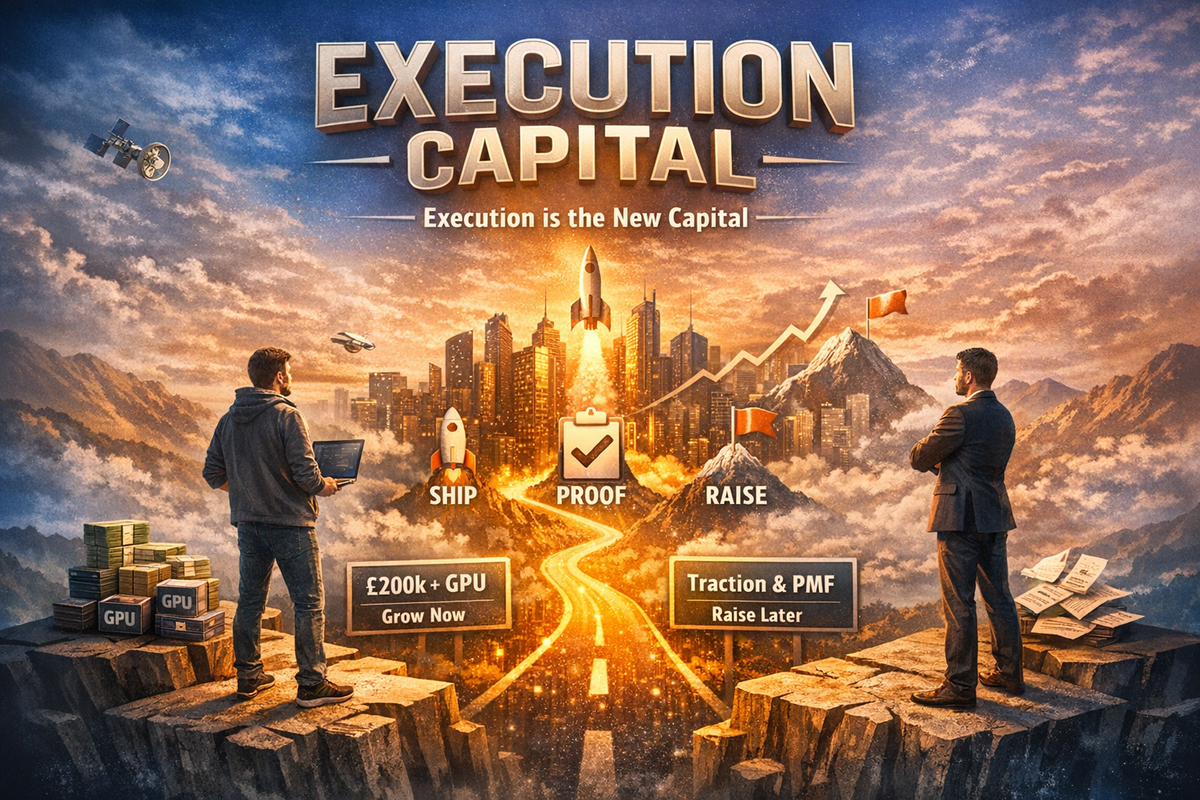

Turn Your Startup Network Into Revenue Without Raising a Fund.
If you know founders who need execution, experts who can deliver, and investors who want proof, you already have everything you need to build a profitable business in 2026.
You just need a different model.
The opportunity hiding in plain sight
Right now, you probably see this pattern weekly:
- Founders stuck in funding loops, burning runway on hiring instead of shipping
- Senior operators giving advice that never gets implemented, with no economic upside
- Investors drowning in polished pitches, starving for real execution data
Traditional accelerators can't solve this. They're built for cohorts, demo days, and equity stakes that take 7+ years to pay off. Solo VCs allocate capital beautifully — but capital alone doesn't ship products, close customers, or build traction.
The Solo Accelerator model allocates something more valuable: outcomes.
And unlike traditional models, you can generate revenue from day one — without raising a fund, without LP obligations, without waiting for exits.
What is a Solo Accelerator?
A Solo Accelerator is a professional operator who deploys execution, not capital.
You take messy founder priorities and convert them into clear Tickets — specific deliverables with milestones, acceptance criteria, and deadlines. Then you deploy a curated bench of senior fractional experts to ship those Tickets. Fast.
Instead of demo day theatre, you create continuous Proof-of-Execution that keeps investors warm and moves valuations.
The simplest way to understand the difference:
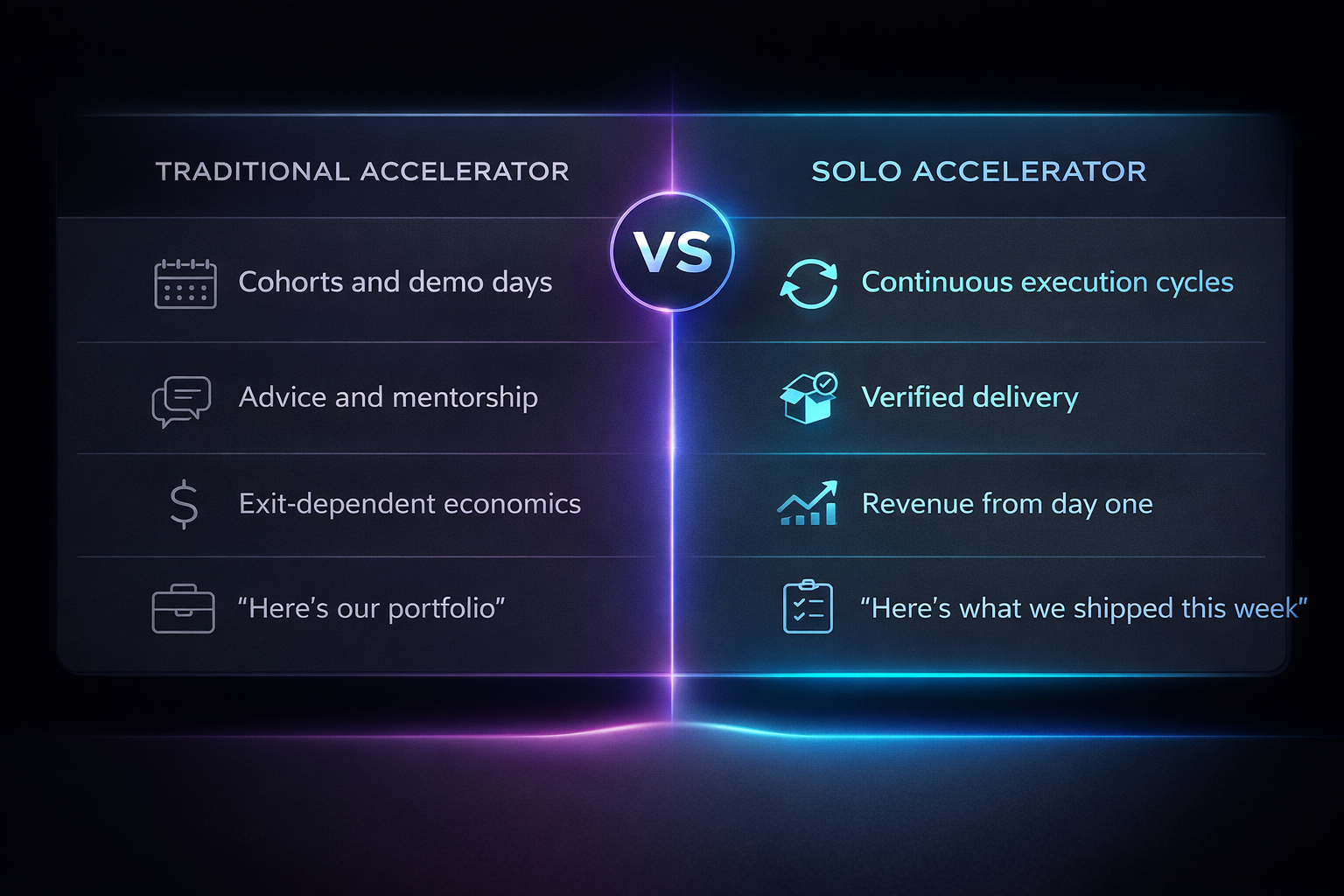
Solo VC allocates capital with taste. Solo Accelerator allocates outcomes with taste.
Why this works now (three forces converging)
1. Software is cheaper to build, but harder to defend
More teams can ship MVPs. Execution speed and early distribution now matter more than perfect positioning.
2. Senior talent went fractional
The best operators don't need office space or equity — they need clear scopes, fair incentives, and immediate liquidity.
3. Investors fund evidence over narratives
In noisy markets, proof compounds faster than pitching. Milestones beat pitch decks.
How Solo Accelerators make money (without waiting for exits)
This is the breakthrough: your economics can be in-year, because revenue ties to execution activity, not distant liquidity events.
Most Solo Accelerators build four streams:
1. Transaction economics
Fees are paid when Tickets are executed, and milestones are verified. Think: "We shipped your MVP architecture, closed your first enterprise customer, or built your compliance framework — here's the invoice."
2. Membership revenue
Structured access for founders who want execution bandwidth, experts who want deal flow, or partners who want portfolio visibility. Monthly or quarterly, predictable.
3. Brand sponsorships
Enterprise brands and platforms looking to innovate through startups will pay for structured access to your portfolio. Instead of running their own "innovation labs" or scanning thousands of startups blindly, they get curated access to companies that are actively shipping. You become their innovation scout with verification built in.
Why brands pay: They want early sight lines to emerging tech, pilot opportunities with working products, and relationships with founders solving real problems in their domains. Your continuous proof-of-execution gives them confidence that these aren't just pitch decks — these are companies that ship.
Example structures: Quarterly sponsorship packages for portfolio access, pilot program coordination fees, or innovation partnership retainers. A Solo Accelerator focused on fintech infrastructure might sponsor from payment processors, cloud providers, or compliance platforms. One focused on AI tooling might attract sponsorship from GPU providers, model vendors, or enterprise AI buyers.
4. Long-term upside participation
Portfolio exposure to the value you create over time — without becoming a fund manager or dealing with LP reporting.
That's a real business. Year one.
Who should become a Solo Accelerator?
You're a strong candidate if you already have:
✓ Founder relationships — they trust you to understand their bottlenecks
✓ Expert networks — you know who actually ships, not just who talks well
✓ Investor proximity — VCs, angels, or operators who value execution data
✓ Operational judgment — you know the difference between "nice-to-have" and "must-ship."
You might be:
- A former operator who's been "advising" founders informally
- A former employee in a leading startup accelerator programme
- A connector who makes intros but wants to capture more value
- An angel investor who wants to help portfolio companies execute
- A community builder sitting on the supply and demand
If you're currently the person founders call when they're stuck, you're already doing this job unpaid.
What you actually do (the six core activities)
Great Solo Accelerators do six things consistently:
1. Find founders with urgent bottlenecks (not "nice-to-have" ideas)
Focus on founders who need to ship in the next 60-90 days to hit milestones that change their trajectory.
2. Design Tickets with unambiguous "done."
"Build MVP" is not a Ticket. "Ship working authentication flow with Google/email login, tested with 10 users" is a Ticket.
3. Curate an elite expert bench (not a directory)
5-10 operators you trust completely. Senior enough to own outcomes, specific enough to be non-interchangeable.
4. Oversee delivery quality
You're not the startup's internal team. You're the quality gate that makes sure work ships and meets acceptance criteria.
5. Publish proof continuously
Weekly or bi-weekly updates showing what shipped. This is how investors stay warm without founders living in pitch mode.
6. Run portfolio discipline
Cadence, reporting, and clean incentives. This is what separates professionals from helpful connectors.
The core insight: Networking isn't the job. Moving tickets to "done" is the job.
How Execution Capital makes this scalable
Here's the problem Solo Accelerators have historically faced: the model is powerful, but doesn't scale because execution markets are messy.
You hit ceilings from:
- Contracting and admin overhead
- Verification disputes ("Is this actually done?")
- Reporting chaos across multiple founders
- Inconsistent incentive structures
- No clean portfolio management system
Execution Capital provides the operating system that removes these bottlenecks:
You own (the value creation):
- Orchestration — moving work to done
- Standards and accountability
- Relationships and reputation
- Proof narrative and investor engagement
Execution Capital provides (the infrastructure):
- Legal structure, governance, compliance guardrails
- Portfolio tools (tracking, reporting, NAV approaches)
- Standardized workflows and Ticket templates
- Investment vehicles for upside participation
- AI-assisted matching and feedback loops
The result: You stay focused on judgment and orchestration. The infrastructure makes you scalable and professional.
The execution transaction (how work actually flows)
Execution Capital standardizes the "execution transaction" so it can repeat safely:
1. Scope — Tickets define deliverables, milestones, acceptance criteria, timeline
2. Bid — Experts bid with timeline + deliverables + cash/GPU split
3. Execute — Work is delivered and logged as artifacts
4. Verify — Founder + Operator verify against acceptance criteria
5. Settle — Cash + GPUs allocated only on verified delivery
Core rule: Execution, not advice. No shipping → no settlement.
Each Solo Accelerator operates in their own ring-fenced vehicle, so your ecosystem doesn't bleed into someone else's.
Why is this powerful for everyone in your network?
For founders:
They get senior execution without burning runway (cash + GPUs model). They stop pitching and start producing proof that changes valuation conversations.
For experts:
They stop "advising" and start shipping, with clear scopes and fair incentives. Immediate liquidity + aligned upside, not vague sweat equity.
For investors:
They get a pipeline with milestone-level evidence, not pitch polish. They can add execution value to portfolios without creating an LP-cost center.
For you:
You move from "helpful connector" to professional operator with repeatable workflows, defensible economics, measurable impact, and scalable reputation built on proof.
How to launch in 30 days
Execution Capital's launch approach isn't about announcements. It's about doing the work and letting proof do the marketing.
Week 1: Positioning
Pick one wedge (AI infrastructure, fintech compliance, B2B sales engines). Publish your standards publicly.
Week 2: Bench
Recruit 20-30 core experts. Align expectations on scopes, settlement, and quality bars. (Execution Capital will help you with that).
Week 3: First cycles
Select 3-5 founders. Design Tickets. Deploy experts. Ship something.
Week 4: Proof + economics
Publish weekly proof. Start an investor feed. Formalize your revenue model.
Reality check: Your title is not the proof. Your cadence is.
The bottom line
The Solo Accelerator model takes the best parts of acceleration — focus, momentum, network effects — and removes what doesn't scale: cohorts, theatre, advice without accountability.
If you already connect founders, experts, and investors, you're sitting on a business that can generate revenue from day one while building long-term portfolio value.
The infrastructure exists. The market demand exists. The talent exists.
The only question: are you ready to turn your network into a scalable execution engine?
 Kevin Monserrat
 Kevin Monserrat